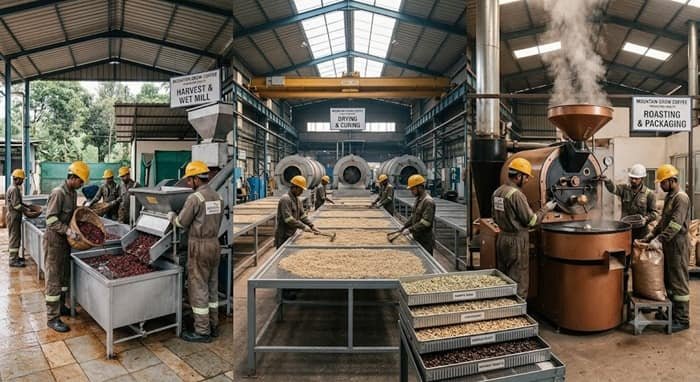
Coffee is the dark, aromatic crop that wakes up India’s hills before it wakes up our mornings. It grows under shade, between silver oak trees, pepper vines, cardamom plants, cool winds and sloping estates. From the misty plantations of Kodagu and Chikkamagaluru to the Robusta gardens of Wayanad and the high ranges of Tamil Nadu, Indian coffee has a very different charm. It is not grown in open plains like many crops. It belongs to hill soil, forest shade, careful picking and patient curing.
For this 2026 list, the ranking is based on the latest Coffee Board of India Post Blossom Estimate 2025–26. India’s total coffee production is estimated at 4,03,000 metric tonnes, including 1,18,125 MT of Arabica and 2,84,875 MT of Robusta.
Now let’s check out the top 5 highest coffee producing states in India in 2026.
1. Karnataka
According to the Coffee Board’s 2025–26 Post Blossom Estimate, Karnataka is expected to produce around 2,80,275 metric tonnes of coffee. This includes 84,925 MT of Arabica and 1,95,350 MT of Robusta.
Karnataka deserves the first position because it is the heart of Indian coffee. The state alone produces nearly 70% of India’s estimated coffee output. Its main coffee districts are Kodagu, Chikkamagaluru and Hassan. These regions have the right mix of rainfall, altitude, shade trees and plantation experience.
Kodagu is one of the most famous coffee belts in India. Chikkamagaluru has a special historic value because Baba Budan Giri is closely connected with the early story of coffee in India. Hassan also contributes strongly, especially from its hilly plantation areas.
Karnataka’s coffee is used in domestic blends, filter coffee, instant coffee, speciality coffee and exports. The state grows both Arabica and Robusta, but Robusta has become the bigger crop because it is hardier and gives better yield in many belts. With strong estates, small growers, curing works, exporters and research support, Karnataka remains India’s coffee capital in 2026.
2. Kerala
The Coffee Board estimates Kerala’s 2025–26 coffee production at around 85,150 metric tonnes. Out of this, 83,000 MT is Robusta and only 2,150 MT is Arabica.
Kerala’s coffee identity is strongly linked with Wayanad, which is the state’s main coffee-growing district. Coffee is also grown in parts of Idukki and other high-range regions, but Wayanad dominates the production story.
Kerala is mainly a Robusta coffee state. Its warm, humid climate and plantation conditions support Robusta better than Arabica in many areas. Robusta from Kerala is widely used in Indian coffee blends and instant coffee production. It gives body, strength and depth to coffee mixtures.
The state’s coffee gardens are often mixed with pepper, banana, arecanut, coconut and other crops. This gives farmers multiple income sources. However, Kerala’s coffee sector also faces challenges from climate change, heavy rainfall, pest pressure and price fluctuation. Still, its strong Robusta base keeps it firmly in second place.
3. Tamil Nadu
Tamil Nadu is the third-largest coffee producing state in India.
In the 2025–26 estimate, Tamil Nadu is expected to produce around 20,315 metric tonnes of coffee. This includes 13,955 MT of Arabica and 6,360 MT of Robusta.
Tamil Nadu’s coffee is mainly grown in the Nilgiris, Yercaud, Kodaikanal, Shevaroy Hills, Palani Hills and Anamalai regions. These hill areas provide suitable altitude, cooler climate and shade conditions for coffee cultivation.
Unlike Kerala, Tamil Nadu has a stronger Arabica profile. Arabica coffee is valued for its aroma, smooth flavour and speciality potential. This gives Tamil Nadu an important place in India’s premium coffee segment, even though its total production is much smaller than Karnataka and Kerala.
Tamil Nadu’s coffee gardens are often located near tea, spices and fruit-growing belts. Plantation tourism, boutique coffee brands and speciality roasting are also slowly giving the state’s coffee a better identity. Its production share may be smaller, but its quality value is strong.
4. Andhra Pradesh
The Coffee Board estimates Andhra Pradesh’s coffee production at around 16,550 metric tonnes in 2025–26. Most of this is Arabica, with 16,480 MT of Arabica and only 70 MT of Robusta.
Andhra Pradesh is the most important coffee producer outside the traditional southern plantation belt. Coffee is mainly grown in the tribal hill regions of Araku Valley and surrounding Eastern Ghats areas. Araku coffee has become one of India’s most recognised speciality coffee names.
The state’s coffee story is also linked with tribal livelihoods. Coffee cultivation in these hill regions has helped many tribal farmers move towards a more stable cash crop. Shade-grown coffee, organic practices and speciality branding have made Andhra Pradesh important even though its total production is lower than Tamil Nadu.
Andhra Pradesh’s strength is quality and identity. Araku coffee has built a strong reputation in premium markets. With better processing, farmer training and branding, the state can continue to grow as a speciality coffee centre.
5. Odisha
According to the Coffee Board’s 2025–26 estimate, Odisha is expected to produce around 500 metric tonnes of coffee, all of it Arabica.
Odisha’s coffee production is still small, but it is important because the state has good future potential. The main coffee-growing belt is Koraput, where hill climate, tribal farming communities and suitable altitude support Arabica cultivation.
Koraput coffee has gained attention in recent years because of its distinct flavour and local identity. The crop is being promoted as a livelihood option for tribal farmers in suitable hill areas. Coffee farming in Odisha is also linked with shade plantations, soil conservation and sustainable hill agriculture.
Odisha is not yet a large coffee producer like Karnataka, Kerala or Tamil Nadu, but it is the leading small producer after Andhra Pradesh in the non-traditional coffee belt. That is why it deserves the fifth position in the 2026 ranking.
Final Words
The top five highest coffee producing states in India in 2026 are Karnataka, Kerala, Tamil Nadu, Andhra Pradesh and Odisha. Karnataka is far ahead and remains India’s coffee capital. Kerala is the strong Robusta centre, Tamil Nadu adds quality hill coffee, Andhra Pradesh is famous for Araku and tribal-grown Arabica, and Odisha is emerging through Koraput coffee.
Together, these states shape India’s coffee identity. From daily filter coffee to export-quality beans, they keep Indian coffee alive in plantations, homes, cafés and global markets.