Cement is the backbone of India’s construction economy. Every highway, bridge, metro pillar, housing project, airport, school building, factory and smart city project needs cement. That is why cement-producing states play a very important role in India’s infrastructure growth.
India is already the second-largest cement producer in the world after China. The country has a huge installed cement capacity, and demand is supported by housing, roads, railways, industrial corridors and urban development. For this 2026 list, the ranking is based mainly on installed cement production capacity, major cement clusters, limestone availability, active plants and recent expansion activity. State-wise actual production can change every year depending on demand and plant utilisation.
Now let’s check out the top 5 cement producing states in India in 2026.
1. Andhra Pradesh
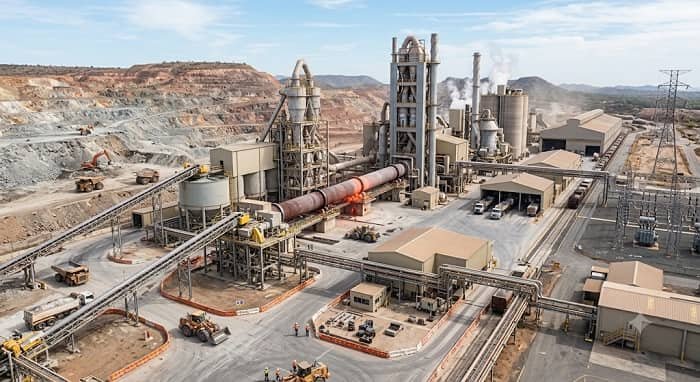
Andhra Pradesh is the largest cement producing state in India in 2026. The state has one of the strongest cement manufacturing bases in the country. A recent industry update reported that Andhra Pradesh leads India with around 62.5 million tonnes of installed cement capacity, ahead of Rajasthan’s 55 million tonnes. This makes Andhra Pradesh the clear leader in cement production capacity at present.
Andhra Pradesh’s biggest strength is its rich limestone belt. Limestone is the main raw material used in cement manufacturing, and the state has major deposits in districts such as Kadapa, Kurnool, Guntur, Anantapur, Nandyal and Palnadu regions. These areas have supported large cement plants for many years.
Major cement companies have strong operations in Andhra Pradesh, especially around Jaggayyapeta, Nandyal, Kadapa and nearby belts. The state also benefits from good transport connectivity, ports, road networks and demand from southern and eastern India.
Andhra Pradesh deserves the first position because it has huge limestone reserves, several integrated cement plants, strong clinker capacity and a long industrial base in cement manufacturing.
2. Rajasthan
Rajasthan ranks second among the top cement producing states in India in 2026. The state has around 55 million tonnes of installed cement capacity, making it one of India’s largest cement hubs. Rajasthan is also expected to challenge Andhra Pradesh for the top position because new plants in Jaisalmer and Nagaur are planned to add nearly 16 million tonnes of extra cement capacity between 2026 and 2029.
Rajasthan’s biggest advantage is its massive limestone reserve. The state is already famous for limestone, marble, sandstone, gypsum and other minerals. Cement production is strong in Chittorgarh, Nimbahera, Pali, Nagaur, Jaisalmer, Kota and Udaipur belts.
Chittorgarh and Nimbahera are among the best-known cement belts in India. Many leading companies operate plants in this region because limestone quality is good and the state is close to major markets in north and west India.
Rajasthan deserves second position because it has a powerful combination of raw material, large plants, strong rail-road connectivity and future expansion. In the next few years, Rajasthan may even become India’s number one cement producing state.
3. Madhya Pradesh
Madhya Pradesh stands third among the major cement producing states in India in 2026. The state has a very strong cement identity, especially in the Satna, Rewa, Maihar, Katni, Neemuch, Dhar and Mandsaur belts. Satna-Maihar-Rewa region is often called one of India’s classic cement belts because of its large limestone deposits and presence of major cement factories.
Madhya Pradesh’s location is also a big advantage. It sits in central India, so cement from the state can move toward north, west, east and south Indian markets. This makes the state attractive for both integrated plants and grinding units.
Recent expansion activity has also strengthened Madhya Pradesh’s position. Adani Group’s cement arm secured land for a 6 MTPA grinding unit at Guna, and another 6 MTPA unit has been proposed in Ujjain. The group already has an operational presence in the state through ACC’s integrated plant at Kymore in Katni district.
Madhya Pradesh deserves third position because of its old cement belt, central location, limestone base and continuing investment from large cement companies.
4. Telangana
Telangana ranks fourth among India’s top cement producing states in 2026. The state became a major cement hub because of its limestone-rich districts and strong industrial connectivity. Cement production is concentrated in areas such as Nalgonda, Suryapet, Vikarabad, Mancherial and parts of the Krishna river belt. Tandur in Vikarabad district is especially known for limestone, cement factories and stone-based industries.
Telangana’s cement strength is closely connected with old Andhra Pradesh’s cement belt. After state bifurcation, both Andhra Pradesh and Telangana continued to remain important cement-producing regions. Telangana has several established cement plants and grinding units operated by well-known companies.
The state also benefits from demand from Hyderabad, industrial corridors, housing projects and infrastructure growth. Cement from Telangana serves local markets as well as neighbouring states such as Maharashtra, Karnataka, Andhra Pradesh and Chhattisgarh.
Telangana deserves fourth position because it has good limestone availability, established cement plants, strong industrial demand and a strategic position in south-central India.
5. Chhattisgarh
The state is already known for minerals, steel, coal and power. Cement is another important part of its industrial economy. Chhattisgarh has large limestone deposits, along with coal and power availability, which are important for cement manufacturing. Major cement activity is seen in Baloda Bazar, Raipur, Durg, Janjgir-Champa and nearby industrial belts.
Baloda Bazar-Bhatapara region is especially important for cement plants. The state has attracted companies because it offers raw material, land, power and access to eastern and central Indian markets. Cement from Chhattisgarh supports construction demand in states like Odisha, Jharkhand, Maharashtra, Madhya Pradesh and Uttar Pradesh.
Chhattisgarh is also an industrial state with strong steel and power sectors. This helps cement companies because heavy industries, roads, housing and infrastructure projects create regular demand for cement.
Chhattisgarh deserves fifth position because it has strong limestone reserves, coal-linked energy support, major cement plants and a growing role in India’s central-eastern cement supply chain.
Final Ranking
Andhra Pradesh currently leads the country in cement capacity, while Rajasthan is rapidly catching up with major new projects. Madhya Pradesh, Telangana and Chhattisgarh remain strong because of limestone reserves, old cement belts and expanding industrial demand. Together, these five states form the real backbone of India’s cement production in 2026.