Crude oil is the black liquid that keeps India’s energy machine moving. Before petrol reaches pumps, diesel powers trucks, ATF lifts aircraft, and petrochemicals enter plastics, fibres and packaging, crude oil begins its journey from deep reservoirs below desert land, river valleys, coastal basins and offshore fields. In India, crude oil production is not spread evenly across the country. A few states and offshore basins carry most of the domestic output.
For this 2026 list, the ranking is based on India’s latest onshore crude oil production pattern, major producing basins, and publicly reported petroleum-sector updates. One important point: Mumbai High and other western offshore fields are very large producers, but they are offshore fields and not counted as a state in this list. India’s crude oil output has also been under pressure; recent reports say domestic crude production declined for the eleventh straight year in 2025–26, increasing concern about import dependence.
Now let’s check out the top 5 crude oil producing states in India in 2026.
1. Rajasthan
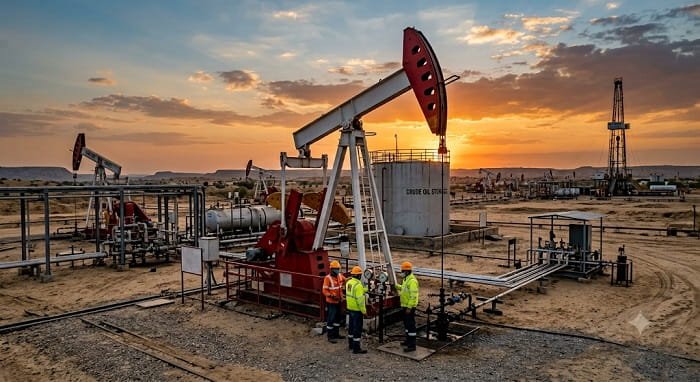
Rajasthan is the largest onshore crude oil producing state in India.
The state’s oil story is mainly built around the Barmer Basin, especially the Mangala, Bhagyam and Aishwariya fields. The Mangala Area in Rajasthan is one of India’s most important onshore oil discoveries and has long been operated by Cairn India/Vedanta with ONGC as a partner.
Rajasthan deserves the first position because its crude oil production changed India’s onshore petroleum map. Before the Barmer discoveries, Assam and Gujarat were the older oil centres. But after the development of the Rajasthan block, Rajasthan became the strongest onshore oil state.
Barmer is the heart of this production. The Mangala Processing Terminal handles crude from the Rajasthan fields, and the heated pipeline system carries waxy crude towards Gujarat for onward refining and transport. The oil from this region is important because it helps reduce India’s dependence on imported crude, even though domestic production still covers only a small part of the country’s demand.
Rajasthan is also building a stronger petroleum ecosystem around the HPCL Rajasthan Refinery at Pachpadra and the Rajasthan Petro Zone. Recent reporting also notes that Rajasthan is already a leader in crude oil and natural gas production in India.
2. Gujarat
Gujarat ranks second among India’s major crude oil producing states.
The state has a long petroleum history through the Cambay Basin, one of India’s classic oil and gas regions. ONGC helped establish Gujarat as an oil province through discoveries in the Cambay basin, along with other producing regions in Assam and the west coast.
Gujarat’s main crude oil producing areas are linked with Ankleshwar, Mehsana, Ahmedabad, Cambay and nearby oil belts. These fields may be older than Rajasthan’s Barmer fields, but they still remain important because of their long production life, mature infrastructure and connection with refineries.
Gujarat’s special strength is that it is not only an oil-producing state but also one of India’s biggest refining and petrochemical hubs. Jamnagar has the world’s largest refinery complex, while Vadodara and other industrial centres add to the state’s petroleum value chain. This gives Gujarat a stronger energy identity than its crude production alone shows.
The state is important because crude oil, refining, petrochemicals, ports and pipelines all work together here. In simple words, Gujarat is both a producing state and a processing powerhouse.
3. Assam
Assam stands third among India’s highest crude oil producing states.
Assam is the birthplace of India’s oil industry. The first commercial oil story of India began in the Digboi region, and even today, Assam remains one of the country’s most important oil states. Oil India Limited is headquartered at Duliajan in Assam and has historically operated major exploration and production assets in the North East.
The major oil-producing regions of Assam include Dibrugarh, Tinsukia, Sivasagar, Charaideo and nearby Upper Assam belts. Fields such as Naharkatiya, Moran, Lakwa, Rudrasagar and Geleki are well known in India’s petroleum history.
Assam’s importance is not only in production volume but also in legacy. It gave India some of its earliest oil wells, refineries and petroleum infrastructure. Digboi Refinery is one of the oldest operating refineries in the world, and Assam also has refineries at Guwahati, Bongaigaon and Numaligarh.
In recent years, Assam has also seen fresh hydrocarbon activity. In 2025, hydrocarbon discovery at Namrup Borhat-1 in Dibrugarh district brought attention to Assam’s continuing oil potential.
4. Tamil Nadu
Tamil Nadu ranks fourth among India’s crude oil producing states.
The state’s crude oil production is mainly connected with the Cauvery Basin, especially areas around Nagapattinam, Ramanathapuram, Thiruvarur and nearby delta/coastal belts. Tamil Nadu is not a large crude oil producer like Rajasthan, Gujarat or Assam, but it has an important place in India’s southern oil map.
ONGC and joint venture operations in the Cauvery Basin have kept Tamil Nadu relevant in crude oil and natural gas production. In 2025, ONGC and its partners restarted production from the PY-3 field in the Cauvery Basin after a long shutdown, showing that the region still has petroleum value.
Tamil Nadu’s crude oil story is also linked with the old Cauvery Basin refinery at Nagapattinam/Narimanam and nearby oil and gas infrastructure. The state’s production is smaller, but strategically important because it diversifies India’s petroleum output beyond western and north-eastern regions.
The main challenge for Tamil Nadu is that many fields are mature and output is limited. Still, because of the Cauvery Basin’s long petroleum history, Tamil Nadu remains among India’s top crude oil producing states.
5. Andhra Pradesh
Andhra Pradesh completes the list of the top five crude oil producing states in India.
The state’s crude oil importance is mainly linked with the Krishna-Godavari Basin and the Ravva oil field near the Andhra coast. The Ravva oil field is located in coastal Andhra Pradesh and has been one of India’s known offshore/near-shore producing assets connected with onshore processing facilities.
Andhra Pradesh has stronger recognition in natural gas because of the KG Basin, but crude oil production also has a place in its energy profile. The KG Basin has attracted ONGC, Reliance, BP and other operators over the years because of its hydrocarbon potential.
The state’s petroleum value is not only about present production but also about future possibilities. Deepwater and offshore exploration in the eastern coast can make Andhra Pradesh more important if new discoveries and better recovery projects succeed.
Andhra Pradesh’s crude oil output is much smaller than Rajasthan, Gujarat and Assam, but its basin potential keeps it inside the top five state-linked producers.
Final Words
The top five crude oil producing states in India in 2026 are Rajasthan, Gujarat, Assam, Tamil Nadu and Andhra Pradesh. Rajasthan leads the onshore crude oil map through the Barmer Basin. Gujarat remains a major producer and refining giant. Assam carries India’s oldest oil legacy and still produces from important Upper Assam fields. Tamil Nadu contributes through the Cauvery Basin, while Andhra Pradesh remains important through the Krishna-Godavari and Ravva-linked petroleum region.
India’s crude oil production is limited compared with its demand, so every domestic producing state has strategic value. Better exploration, enhanced oil recovery, new basin development and faster project execution will decide whether India can reduce some part of its heavy crude import dependence in the coming years.