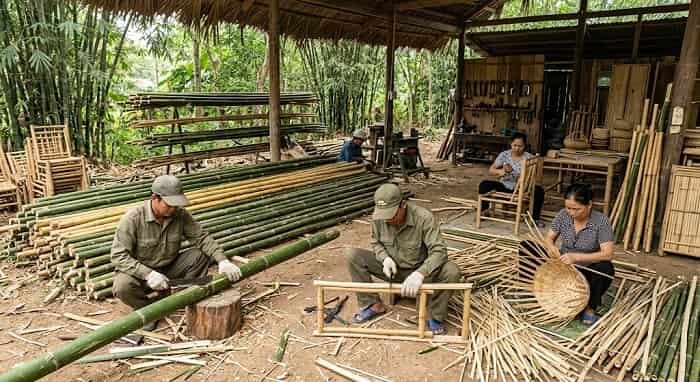
Bamboo is one of India’s most useful natural resources. It grows fast, regenerates quickly and supports many rural livelihoods. From baskets, mats and furniture to paper, incense sticks, handicrafts, housing material, bio-energy and engineered bamboo products, this plant has moved far beyond its old image as a forest product.
The importance of bamboo is also rising because it fits well with green industry. It can support tribal communities, artisans, farmers, small factories and eco-friendly construction. In many states, bamboo is no longer seen only as a wild forest resource; it is now being promoted as a crop, a business material and a climate-friendly income source.
For this 2026 list, the ranking is based on bamboo-bearing area, natural resource strength, cultivation base, commercial use, forest dependence and recent bamboo-development activity. Bamboo production data is not always reported like rice, wheat or fruits, so the list is best understood as India’s top bamboo-producing and bamboo-resource states.
Now let’s check out the top 5 bamboo producing states in India in 2026.
1.Madhya Pradesh
Madhya Pradesh is one of the most important bamboo producing states in India.
The state has a huge forest base, and bamboo-bearing areas are widely distributed in its forests. Bamboo is found along with teak, sal and mixed forest formations, especially in central, eastern and southern parts of the state. Districts such as Balaghat, Mandla, Dindori, Seoni, Betul, Chhindwara, Shahdol, Umaria and parts of Jabalpur and Narmadapuram region are important for forest-based bamboo availability.
Madhya Pradesh deserves the first position because of its large forest area and deep connection with minor forest produce. Bamboo supports tribal communities, local artisans, forest workers and small rural enterprises. It is used for household articles, fencing, construction support, baskets, mats, agricultural tools and many traditional products.
The state also has strong potential for bamboo-based industries. Because Madhya Pradesh is located in central India, bamboo from the state can move towards markets in Maharashtra, Chhattisgarh, Uttar Pradesh, Rajasthan and Gujarat. This gives it a natural market advantage.
Madhya Pradesh’s forest profile is one of the strongest in the country. Recent forest-cover reporting also shows that the state retains India’s largest forest cover, which strengthens its position in forest-linked bamboo resources.
2. Arunachal Pradesh
Arunachal Pradesh ranks second among India’s top bamboo producing states.
The state is naturally rich in bamboo because of its high rainfall, hilly terrain, dense forests and North Eastern biodiversity. Bamboo grows widely across the state and is deeply connected with local life. It is used in houses, bridges, fences, baskets, mats, tools, food, handicrafts and traditional architecture.
Important bamboo-rich areas are spread across districts such as Papum Pare, Lower Subansiri, West Kameng, East Kameng, Changlang, Lohit, Namsai, Tirap and Lower Dibang Valley. Many tribal communities in Arunachal Pradesh have used bamboo for generations, and this traditional knowledge gives the state a special place in India’s bamboo map.
Arunachal Pradesh’s importance is not only natural availability. The state is now trying to convert bamboo into a stronger economic sector. In June 2026, the Arunachal Pradesh Bamboo & Cane Technology Centre was inaugurated near Itanagar, with the aim of promoting entrepreneurship, employment and sustainable development through bamboo and cane resources.
The state deserves the second position because it combines rich bamboo forests, traditional bamboo use and new institutional support for value addition.
3. Maharashtra
Maharashtra stands third among India’s leading bamboo producing states in 2026.
The state has become one of the most active bamboo-development regions in India. Bamboo is found in forest and plantation belts of Vidarbha, Konkan and parts of western Maharashtra. Major bamboo-linked districts include Gadchiroli, Chandrapur, Bhandara, Gondia, Amravati, Nagpur, Sindhudurg, Ratnagiri and Kolhapur.
Vidarbha is especially important because it has forest resources, fallow lands and suitable conditions for bamboo expansion. Bamboo is used here for household products, agri-support material, handicrafts, construction items, bio-energy and industrial raw material.
Maharashtra’s position became stronger after the state approved its Bamboo Industry Policy 2025. The policy aims to make Maharashtra a national hub for bamboo-based industries. It also mentions that the state ranks third in India in bamboo cultivation area, covering about 1.35 million hectares, with current output of 9.47 lakh tonnes. Major clusters are planned in areas such as Amravati and Bhandara.
Maharashtra deserves third position because it has both resource strength and a clear industrial plan. The state is not only growing bamboo; it is trying to build a full bamboo economy around farmers, artisans, FPOs, processing units and green industries.
4. Odisha
Odisha ranks fourth among the top bamboo producing states in India.
The state has a strong forest-based economy, and bamboo is an important minor forest produce in many tribal and forest districts. Bamboo grows in several parts of Odisha’s forest landscape and supports rural households, traditional crafts, forest workers and small businesses.
Major bamboo-linked regions include Mayurbhanj, Sundargarh, Kandhamal, Koraput, Rayagada, Kalahandi, Malkangiri, Keonjhar, Sambalpur and Gajapati. Bamboo is used for baskets, mats, rural housing support, agricultural tools, fencing and handicrafts. It also has importance for wildlife habitat, especially in forest regions where bamboo supports herbivores and helps improve ecological balance.
Odisha’s bamboo strength is supported by its forest area. Older forest data notes that the state had more than 10,000 sq km of bamboo forests, which shows the depth of its bamboo resource base.
The state is also trying to improve forest-based livelihoods. Odisha has announced plans to set up processing centres for forest products such as sal, tamarind, bamboo and medicinal plants, with the aim of creating green livelihoods and increasing tribal income.
Odisha deserves fourth position because bamboo is part of its forest economy, tribal livelihood system and future green-industry planning.
5. Mizoram
Mizoram completes the list of the top five bamboo producing states in India in 2026.
Bamboo is almost a part of Mizoram’s identity. The state’s hills, forests and village life are closely linked with bamboo. It is used in homes, fencing, bridges, furniture, baskets, mats, musical instruments, handicrafts and even food in the form of bamboo shoots.
Mizoram has a very strong bamboo resource base for its size. Bamboo is common in the state’s forests, and around 9,245 sq km, or about 44% of the state’s area, is bamboo-bearing. Mizoram is also described as one of India’s leading bamboo producers, with 27 species of bamboo and a notable share in commercial bamboo supply.
The state is also building processing capacity. In 2025, bamboo processing units were inaugurated at the Sairang Horticulture Centre under the National Bamboo Mission to support value addition, employment and sustainable bamboo-based development.
Mizoram’s position in the top five comes from its dense bamboo presence, traditional bamboo culture and growing focus on processing. Even though the state is small, bamboo plays a bigger role here than in many larger states.
Final Words
The top five bamboo producing states in India in 2026 are Madhya Pradesh, Arunachal Pradesh, Maharashtra, Odisha and Mizoram. These states carry India’s bamboo strength through forests, plantations, tribal skills, processing units and new green-industry policies.
Bamboo has the power to become one of India’s best rural-economy crops if states improve cultivation, harvesting, processing, design, branding and market access.