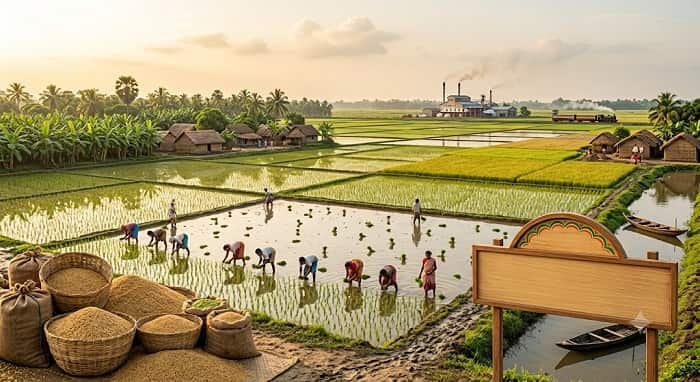
Paddy is the crop that fills India’s grain bowl. Before rice reaches ration shops, wholesale markets, mills, exporters and homes, it begins as green fields standing in water under the monsoon sky. For millions of farmers, paddy is not just a crop; it is the main season of work, income and food security.
India’s rice economy is also connected with irrigation, government procurement, MSP, storage, exports and household food prices. A good paddy season strengthens food stocks, while poor rainfall or delayed sowing can quickly create pressure on farmers and markets. In 2025–26, India’s rice output touched a record level, and government rice stocks also rose sharply, showing how important paddy remains for national food security.
For this 2026 list, “paddy producing states” means the major rice/paddy producing states based on latest production strength, acreage, procurement activity, traditional growing belts and recent agricultural updates. In official crop data, production is often reported as rice, while state procurement data is usually reported as paddy. So this ranking considers both paddy and rice strength.
Now let’s check out the top 5 paddy producing states in India in 2026.
1.West Bengal
West Bengal is one of the strongest paddy producing states in India and remains at the top of the country’s rice economy.
The state has a natural advantage because of its fertile alluvial plains, heavy monsoon rainfall, river systems and high rural dependence on farming. Rice is the main food crop of Bengal, and paddy cultivation is spread across almost every part of the state. The crop is deeply connected with local food culture, rural labour, small farmers and village markets.
Major paddy-producing districts include Bardhaman, Birbhum, Bankura, Murshidabad, Nadia, Hooghly, North 24 Parganas, South 24 Parganas, Paschim Medinipur, Purba Medinipur, Malda and Uttar Dinajpur. The state grows aus, aman and boro paddy, which gives it multiple rice seasons and a strong production base.
West Bengal’s strength is its wide cultivation pattern. Many farmers grow paddy on small holdings, and the crop fits well with the state’s water-rich ecology. The state is widely recognised as India’s largest rice-producing region, with rice and potato counted among its principal food crops.
West Bengal deserves the first position because rice is not only a crop here; it is the centre of farming, food habits and rural trade.
2. Uttar Pradesh
Uttar Pradesh ranks second among India’s top paddy producing states in 2026.
The state has one of the largest agricultural bases in India. Its fertile Indo-Gangetic plains, canal irrigation, tube wells and huge farming population make it a natural paddy-growing region. Rice is grown widely along with wheat, sugarcane, pulses, potatoes and other food crops.
Major paddy-producing belts include eastern Uttar Pradesh, Terai areas and parts of central and western UP. Important districts include Gorakhpur, Maharajganj, Kushinagar, Deoria, Bahraich, Gonda, Lakhimpur Kheri, Sitapur, Barabanki, Pilibhit, Shahjahanpur, Varanasi, Ghazipur and Prayagraj region.
Uttar Pradesh’s strength is scale. Even if productivity varies from region to region, the state’s large cultivated area keeps it among the biggest paddy producers. It is also India’s largest food grain producing state, with rice listed among its major food grain crops.
The state also has a large procurement system. In the 2025–26 paddy season, lakh of farmers registered for paddy sale under MSP operations, showing the importance of the crop for farmer income in UP.
3. Telangana
Telangana has become one of India’s fastest-rising paddy producing states.
The state’s paddy story has changed strongly in the last few years because of irrigation expansion, assured procurement, farmer support and large-scale cultivation in both kharif and rabi seasons. Paddy has become so dominant that Telangana is now counted among the country’s top three paddy-producing states.
Major paddy-growing areas include Nalgonda, Nizamabad, Karimnagar, Warangal, Siddipet, Suryapet, Jagtial, Kamareddy, Mahabubnagar, Peddapalli and parts of Khammam and Medak regions. The state grows both common and fine varieties, and fine paddy has received extra attention because of bonus support.
Telangana’s recent production and procurement numbers show its rapid rise. In 2025–26, the state planned a huge kharif procurement drive, expecting a record harvest from around 66.8 lakh acres. It also planned to purchase 80 lakh metric tonnes of paddy during the season.
The state deserves third position because it has moved from being a regional rice producer to a national paddy powerhouse. At the same time, this growth has also created debate over crop diversification because too much paddy can put pressure on water, storage and procurement systems.
4. Punjab
Punjab ranks fourth among India’s leading paddy producing states in 2026.
Punjab is better known for wheat, but it is also one of India’s most important rice-producing states. The state has very high productivity because of assured irrigation, mechanised farming, strong procurement, good mandi systems and experienced farmers. Even with a smaller geographical area, Punjab contributes a major share to India’s rice supply.
Important paddy-growing districts include Ludhiana, Sangrur, Patiala, Moga, Firozpur, Fazilka, Bathinda, Barnala, Muktsar, Tarn Taran and Amritsar. Paddy is usually grown in the kharif season and followed by wheat in the rabi season, creating the famous rice-wheat cropping cycle of Punjab.
Punjab’s importance is visible in its national contribution. The state accounts for around 11–12% of India’s rice production and is called one of India’s key food-basket states.
However, Punjab’s paddy sector also faces a serious water challenge. Continuous paddy cultivation has increased groundwater stress in many areas. This is why crop diversification, direct seeded rice, short-duration varieties and water-saving practices are becoming important for the state’s future.
5. Chhattisgarh
Chhattisgarh completes the list of the top five paddy producing states in India in 2026.
The state is often called the “Rice Bowl of Central India” because paddy is the main crop for a large number of farmers. It is grown across plains, tribal belts and irrigated as well as rainfed regions. Rice farming is deeply linked with food habits, rural income and government procurement in the state.
Major paddy-producing districts include Raipur, Dhamtari, Mahasamund, Bilaspur, Janjgir-Champa, Baloda Bazar, Rajnandgaon, Durg, Bemetara, Kanker and parts of Bastar region. Many local and traditional rice varieties are also grown in different parts of Chhattisgarh.
The state has a very strong procurement system. During the 2025–26 kharif marketing season, Chhattisgarh purchased about 141.04 lakh metric tonnes of paddy from more than 25 lakh farmers, showing the huge scale of its paddy economy.
Chhattisgarh deserves a top-five place because paddy is not just one crop here; it is the base of the state’s rural economy, public procurement system and farmer welfare policies.
Final Words
The top five paddy producing states in India in 2026 are West Bengal, Uttar Pradesh, Telangana, Punjab and Chhattisgarh. These states keep India’s rice supply strong through fertile plains, irrigation, farmer experience, procurement networks and large-scale cultivation.
Paddy will remain one of India’s most important food crops, but its future will depend on balanced farming, better water use, improved varieties, storage support and fair prices for farmers.