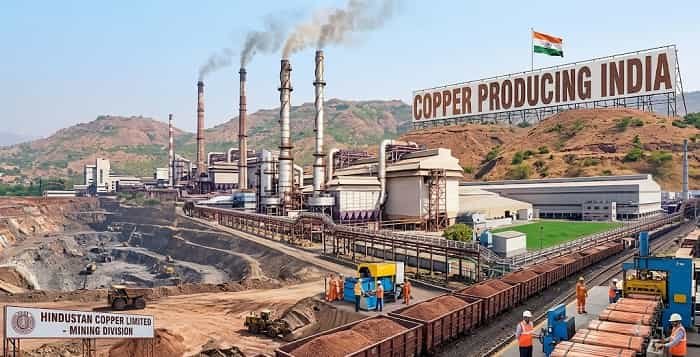
Copper is the red metal that quietly powers modern India. It runs inside electric wires, motors, transformers, railway systems, solar plants, construction equipment, electronics, defence items and industrial machinery. Before it becomes a cable, a coil or a conductor, copper begins its journey inside hard rock mines, where ore is extracted, crushed, beneficiated and turned into concentrate.
The Ministry of Mines says India’s estimated copper concentrate production in 2025–26 is 105.98 thousand tonnes, and Hindustan Copper Limited is the sole producing company. It also states that Madhya Pradesh and Rajasthan are the major copper concentrate producers.
So, the first three states in this article are actual copper ore/mining states. Gujarat and Maharashtra are included because they are important copper-industry states, but they are not major copper ore producing states in the latest official production ranking.
Now let’s check out the top copper producing and copper-linked states in India in 2026.
1. Madhya Pradesh
Madhya Pradesh is the largest copper producing state in India in 2026.
According to the Ministry of Mines Annual Report 2025–26, Madhya Pradesh accounts for 66.10% of India’s estimated copper concentrate production in 2025–26. In the 2024–25 mineral production scenario, the state also accounted for 76.61% of India’s copper ore production and 71.18% of copper concentrate production.
The main reason behind Madhya Pradesh’s leadership is the Malanjkhand Copper Project in Balaghat district. It is India’s most important copper mining centre and is operated by Hindustan Copper Limited. The Ministry report mentions that in CY 2025, the Malanjkhand Copper Project achieved 2.60 million tonnes of ore production, which was far higher than the Khetri unit in Rajasthan.
Madhya Pradesh deserves the first position because it is the real backbone of India’s copper mining. The state has large copper-bearing deposits, active mining operations and strong concentrate production. Copper from Malanjkhand supports industries that need domestic copper raw material, especially when India is still dependent on imported copper concentrate for a large part of its refined copper demand.
2. Rajasthan
Rajasthan ranks second among the highest copper producing states in India.
In the latest 2025–26 estimate, Rajasthan contributes 33.90% of India’s copper concentrate production. In the 2024–25 mineral production scenario, Rajasthan had a 20.19% share in copper ore and 28.82% share in copper concentrate.
Rajasthan’s copper industry is mainly linked with the Khetri Copper Belt in Jhunjhunu district. The Khetri Copper Complex is one of India’s oldest and most famous copper mining centres. It has been associated with copper mining for a long time and remains one of Hindustan Copper Limited’s key units.
The Ministry report says that in CY 2025, the Khetri Copper Complex achieved 0.82 million tonnes of ore production. This makes Rajasthan the second most important active copper mining state after Madhya Pradesh.
Rajasthan is also important from a resource point of view. The Ministry report says Rajasthan has 867.85 million tonnes of copper ore resources, accounting for 52.25% of India’s copper ore resources. This gives the state long-term importance even beyond its current production share.
3. Jharkhand
Jharkhand stands third among India’s copper ore producing states.
In the 2024–25 official mineral production scenario, Jharkhand accounted for 3.19% of India’s copper ore production. Its copper concentrate share was shown as zero in that table, but it still remains an important copper-bearing state because of its mining history and resource base.
Jharkhand’s copper identity is mainly connected with the Singhbhum copper belt, especially areas around Ghatsila and Surda. This belt has been one of India’s traditional copper mining regions. Hindustan Copper Limited’s Indian Copper Complex is located in Jharkhand, and the company’s official presence in the state keeps Jharkhand relevant in India’s copper map. The Ministry report also says HCL has units in Rajasthan, Jharkhand, Madhya Pradesh, Maharashtra and Gujarat.
Jharkhand also has strong copper resources. The Ministry report places Jharkhand at 251.46 million tonnes of copper ore resources, or 15.14% of India’s total copper ore resource base.
So, even though Jharkhand’s current production share is much smaller than Madhya Pradesh and Rajasthan, it remains India’s third key copper mining state.
4. Gujarat
Gujarat is not a major copper ore producing state in the latest official mining data, but it is one of India’s most important copper-industry states.
The Ministry’s 2024–25 mineral scenario shows Gujarat with zero share in copper ore and copper concentrate production. However, Gujarat has become very important in refined copper and smelting activity. Reuters reported that Adani’s Kutch Copper facility in Gujarat has an annual capacity of 500,000 metric tonnes and is described as the world’s largest single-location copper smelter of its type.
This makes Gujarat different from Madhya Pradesh and Rajasthan. It may not lead in copper mining, but it plays a big role in copper metal production, smelting, refining and industrial supply chains. With the rise of Kutch Copper and the presence of large industrial ports, Gujarat is becoming a major copper processing and manufacturing hub.
For readers, this difference is important: Madhya Pradesh and Rajasthan produce copper concentrate from mines, while Gujarat’s strength is more in smelting and refined copper production using concentrate, including imported concentrate.
5. Maharashtra
Maharashtra completes this list as a copper-linked industrial state, not as a major copper ore producing state.
The latest official mineral production table does not place Maharashtra among copper ore or copper concentrate producing states. But Maharashtra is connected with Hindustan Copper Limited through the Taloja Copper Project in Raigad district. The Ministry report mentions HCL’s Taloja unit and says it achieved 14,942 tonnes of continuous cast copper rod production in CY 2025 through third-party tolling.
Maharashtra’s importance comes from downstream copper use. The state has a large industrial base, electrical goods market, construction sector, transport network and manufacturing ecosystem. Copper rods, wires and other copper-based products are important for industries in and around Mumbai, Pune, Nashik, Raigad and other industrial belts.
So, Maharashtra is not a top copper mining state, but it remains relevant in India’s copper value chain because of processing, industrial consumption and downstream copper products.
Final Words
The top actual copper producing states in India in 2026 are Madhya Pradesh, Rajasthan and Jharkhand. Madhya Pradesh leads clearly because of Malanjkhand, Rajasthan follows through the Khetri copper belt, and Jharkhand remains important through the Singhbhum belt and its copper resource base.
Gujarat and Maharashtra are included only as copper-industry states because India does not currently have five major copper ore producing states. Gujarat is rising as a refined copper and smelting hub, while Maharashtra is important for copper rod and downstream industrial use.
In simple words, India’s copper mining map is small but strategic. Madhya Pradesh and Rajasthan dominate current concentrate production, Jharkhand keeps the historical mining belt alive, and Gujarat-Maharashtra strengthen the copper industry beyond mining.