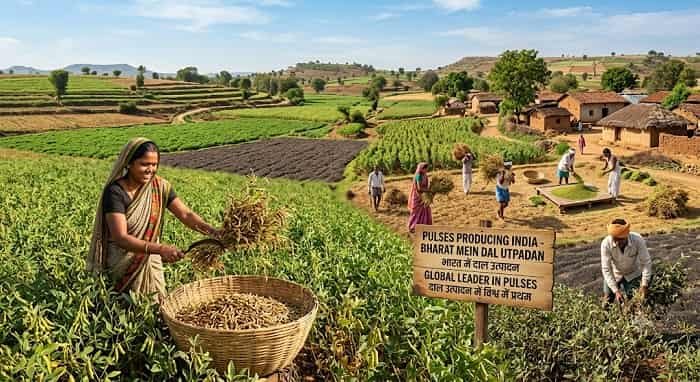
Pulses are the protein backbone of Indian food. Dal, chana, arhar, moong, urad, masoor and peas are eaten across the country, from simple home meals to large community kitchens. For farmers, pulses are also valuable because many of them need less water than paddy or sugarcane and can improve soil health by adding nitrogen naturally.
India grows pulses in kharif, rabi and summer seasons, but the country still imports part of its demand. That is why pulse-producing states are very important for food security, farmer income and stable dal prices. NITI Aayog’s recent roadmap aims to raise India’s pulses production from 26.06 million tonnes in 2022 to 34.45 million tonnes by 2030, showing how seriously the country is looking at pulse self-sufficiency.
The ranking is based on the latest available production pattern, state-level updates, major pulse belts, crop diversity and recent growth trends.
Now let’s check out the top 5 pulses producing states in India in 2026.
1. Madhya Pradesh
Madhya Pradesh is the largest pulses producing state in India in 2026.
The state has one of the strongest pulse-growing systems in the country. Gram, arhar, urad, moong, lentil and peas are grown across different regions, but gram or chana is the biggest strength of Madhya Pradesh. The state’s dry climate, black soil, rabi farming pattern and large agricultural base make it highly suitable for pulse cultivation.
Major pulse-producing districts include Vidisha, Sagar, Narsinghpur, Raisen, Sehore, Chhindwara, Damoh, Jabalpur, Ujjain, Dewas, Mandsaur, Neemuch and parts of the Malwa and Bundelkhand belts. Gram is especially strong in central and western Madhya Pradesh, while urad and moong are grown in several kharif and summer pockets.
Madhya Pradesh has long been counted as India’s biggest contributor to pulses, with older state agriculture data placing its share near one-fourth of national output. The state is also one of the major regions that recorded strong post-2004 growth in pulse output, along with Rajasthan and Maharashtra.
Madhya Pradesh deserves the first position because it has large area, strong chana production, suitable dryland conditions and deep farmer experience in pulse crops. Pulses are not a side crop here; they are one of the main pillars of the state’s rabi agriculture.
2. Rajasthan
Rajasthan ranks second among India’s top pulses producing states.
The state has become a major pulse powerhouse because of its dry and semi-arid farming conditions. Pulses grow well in many parts of Rajasthan because they can survive with less water compared with several other crops. The state is especially important for gram, moth bean, moong, urad and other dryland pulses.
Major pulse-growing regions include Nagaur, Bikaner, Churu, Jodhpur, Barmer, Jaipur, Ajmer, Kota, Bundi, Tonk, Sikar, Jhunjhunu and parts of the Hadoti and Shekhawati belts. In western Rajasthan, moth bean and moong are important, while gram is widely cultivated in rabi season.
Rajasthan’s rise in pulses has been very strong. A NITI Aayog-linked report mentioned Rajasthan’s post-2004 pulse-output growth at 8.05%, higher than many other major states. This shows how quickly Rajasthan has expanded its role in India’s pulse economy.
The state deserves second position because it has large dryland area, strong gram and moong production, and a farming system naturally suited to low-water crops. Rajasthan’s importance will grow further as India pushes for less water-intensive and climate-resilient agriculture.
3. Maharashtra
Maharashtra stands third among the highest pulses producing states in India.
The state has a strong pulse base in both kharif and rabi seasons. Tur or arhar is one of Maharashtra’s most important pulse crops, especially in Vidarbha, Marathwada and parts of western Maharashtra. Gram, moong, urad and lentil are also grown in many districts.
Major pulse-producing regions include Akola, Amravati, Yavatmal, Wardha, Nagpur, Latur, Beed, Osmanabad, Jalna, Nanded, Solapur, Ahmednagar and parts of Pune and Nashik. Vidarbha and Marathwada are especially important for tur and gram.
Maharashtra’s pulse sector is valuable because the state has both production and processing strength. Many dal mills, traders and food-processing units are connected with the crop. Maharashtra is also one of the states that has shown strong growth in pulse production after 2004, with growth reported at 4.61%, above the national average mentioned in the same report.
The state also has recognised pulse identities. Borsuri Tur Dal from Maharashtra received GI recognition, which shows how regional pulse varieties can build market value beyond ordinary mandi sales.
Maharashtra deserves third position because of its strong tur belt, wide gram cultivation, dal-processing network and major role in India’s pulse supply chain.
4. Uttar Pradesh
Uttar Pradesh ranks fourth among India’s top pulses producing states in 2026.
The state has a large farming base and grows pulses across zayed, kharif and rabi seasons. Important crops include arhar, urad, moong, gram, lentil and peas. Pulses are especially important in Bundelkhand, eastern Uttar Pradesh and parts of central UP, where farmers need crops that can fit into different soil and water conditions.
Major pulse-producing districts include Banda, Jhansi, Hamirpur, Mahoba, Lalitpur, Chitrakoot, Kanpur, Fatehpur, Prayagraj, Varanasi, Mirzapur, Gorakhpur and parts of the Terai and Awadh regions. Bundelkhand is especially important because pulses suit its dry farming conditions.
Uttar Pradesh currently produces around 30 lakh tonnes of pulses and has productivity above 12 quintals per hectare, higher than the national average of 9.26 quintals per hectare. The state ranked fourth in national pulse production in 2024–25 and contributed around 12% of India’s total output.
The state is also working to expand pulse production by nearly 20%, with focus on urad and moong in zayed, arhar, urad and moong in kharif, and matar with moong in rabi. This makes Uttar Pradesh one of the most important states for India’s future pulse self-reliance.
5. Gujarat
Gujarat completes the list of the top five pulses producing states in India in 2026.
The state has shown strong growth in pulse production in recent years. Gram is the biggest pulse crop in Gujarat, followed by pigeon pea, black gram, green gram and moth bean. Pulses are grown in Saurashtra, north Gujarat, central Gujarat and parts of Kutch.
Important pulse-growing districts include Banaskantha, Patan, Mehsana, Sabarkantha, Rajkot, Junagadh, Amreli, Jamnagar, Bhavnagar, Anand and parts of Kutch. Gram is especially important because it contributes the largest share of the state’s pulse output.
Gujarat’s pulse production doubled between 2019–20 and 2024–25. The area under pulses increased from 9 lakh hectares to 14.39 lakh hectares, while production rose strongly. Chickpea alone increased from 6.36 lakh metric tonnes in 2019–20 to 15.63 lakh metric tonnes in 2024–25, making it the backbone of Gujarat’s pulse economy.
Gujarat deserves fifth position because of its fast growth, strong chickpea base, better productivity and active market links. The state may not be as old a pulse giant as Madhya Pradesh or Rajasthan, but its recent progress has made it one of India’s most important pulse-producing states.
Final Words
The top five pulses producing states in India in 2026 are Madhya Pradesh, Rajasthan, Maharashtra, Uttar Pradesh and Gujarat. These states support India’s dal supply through gram, tur, moong, urad, lentil and peas.
Pulses will remain important for nutrition, soil health and farmer income. Better seeds, MSP procurement, storage, processing and stable prices can make India stronger in pulse production.