Almond is one of India’s premium dry fruits, but its farming is very limited compared with fruits like apple, banana or mango. The crop needs cool winters, dry conditions during maturity, proper chilling hours and careful orchard management. That is why almond cultivation in India is mainly restricted to Himalayan and cold temperate regions, while most of the country’s demand is still met through imports.
India domestic almond production is small and is mainly concentrated in Jammu & Kashmir and Himachal Pradesh. India’s almond production for marketing year 2025–26 was forecast around 4,100 tonnes, slightly lower than the previous year because of climate disruption and insufficient soil moisture in the top almond-growing regions.
Now let’s check out the top 5 almond producing and almond-growing states/regions in India in 2026.
1. Jammu & Kashmir
Jammu & Kashmir is the largest almond producing region in India in 2026.
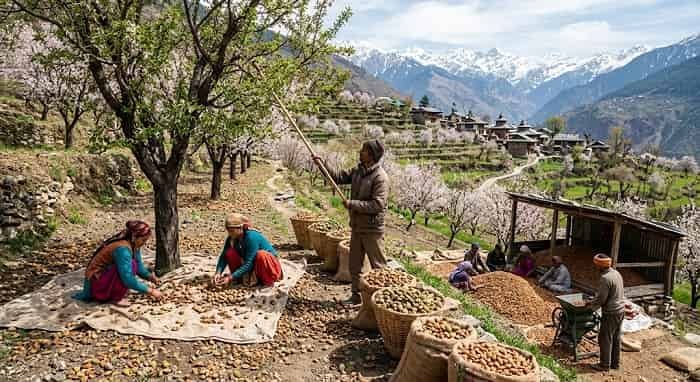
The almond identity of India is mainly built around Kashmir. Almond trees are grown in the Valley’s temperate climate, where cold winters and dry summer conditions support nut development. The crop is especially linked with areas around Srinagar, Budgam, Pulwama, Shopian, Anantnag, Ganderbal and parts of Baramulla.
Jammu & Kashmir is not only known for apples and walnuts; almonds are also a recognised part of its horticulture economy. In 2026, NITI Aayog proposed “Operation Golden Greens” for horticulture transformation in J&K, focusing on major regional products such as apples, walnuts, almonds and saffron. This shows that almonds remain important in the region’s future horticulture planning.
The state’s almond culture is also visible in Kashmir’s spring season. Almond blossoms are among the earliest signs of spring in the Valley, and places like Badamwari in Srinagar are strongly associated with almond flowering. However, changing weather is becoming a serious issue. In February 2026, Kashmir saw almond and fruit blossoms appearing weeks earlier than usual because of an unusually warm winter, raising concern about late frost and disturbed pollination.
Jammu & Kashmir deserves the first position because it has the strongest almond-growing tradition, the best-known orchard base and the clearest market identity for Indian almonds.
2. Himachal Pradesh
Himachal Pradesh ranks second among India’s almond producing states.
The state has several cold temperate fruit belts where almonds can grow along with apples, walnuts, apricots, cherries, peaches and plums. Almond cultivation is mainly found in selected higher and drier pockets, especially in districts such as Kinnaur, Lahaul-Spiti, Chamba, Kullu, Mandi and parts of Shimla.
Himachal Pradesh’s almond production is much smaller than its apple production, but the state is still counted among India’s top almond-growing regions. Its hill climate, orchard farming culture and experience with temperate fruits give it a natural advantage. The same crop-care skills used in apples and walnuts also help farmers manage almond orchards.
The state’s challenge is weather instability. Almond trees need proper winter chilling and stable flowering conditions. When winters become too warm or spring weather turns erratic, flowering and fruit setting can suffer. This is the same broader climate pressure that is now affecting many temperate fruit crops in the Himalayan region.
Himachal Pradesh deserves second position because it has suitable high-altitude belts, experienced orchard growers and a strong temperate-fruit economy.
3. Ladakh
Ladakh holds an important place among India’s almond-growing regions.
Ladakh is not a large producer, but its cold desert climate is suitable for selected dry fruits and temperate fruits. Almonds are grown in small pockets along with apricots, walnuts and apples. The crop is mainly linked with lower-altitude and relatively warmer valleys where irrigation from glacier-fed streams supports fruit trees.
Important almond-growing areas are found around Leh, Kargil, Sham Valley, Nubra and other suitable valley belts. In Ladakh, orchard farming depends heavily on altitude, water availability and protection from extreme cold. Because the growing season is short, farmers usually prefer hardy fruit crops that can survive dry mountain conditions.
Ladakh’s strength is quality and natural growing conditions rather than large production volume. Its dry climate can help produce good-quality nuts where trees are properly managed. The region also has growing potential for branded dry fruits and mountain horticulture products.
Ladakh is included in this list because India’s almond production is highly concentrated in cold regions, and Ladakh remains one of the few places where almonds can be grown naturally.
4. Uttarakhand
Uttarakhand ranks fourth among India’s almond-growing states.
The state has suitable pockets for temperate horticulture in its higher hill districts. Almond cultivation is found on a limited scale in areas where climate, altitude and soil conditions support nut trees. Districts such as Pithoragarh, Chamoli, Uttarkashi, Almora, Bageshwar and parts of Nainital have potential for temperate fruits and dry fruits.
Uttarakhand’s almond production is not very large, but the crop has value in hill farming. Farmers in suitable areas can grow almonds along with walnut, apricot, pear, plum and apple. This kind of mixed orchard system helps reduce risk because farmers do not depend on only one fruit crop.
The state’s advantage is its Himalayan climate and growing focus on high-value horticulture. Almond can become useful in selected pockets where farmers have access to good planting material, irrigation and local marketing support.
Uttarakhand deserves fourth position because it has natural hill conditions and future potential, even though its present almond production remains limited.
5. Arunachal Pradesh
Arunachal Pradesh completes the list of the top five almond producing and almond-growing states in India in 2026.
The state is better known for kiwi, orange, apple, walnut and other horticulture crops, but selected high-altitude areas also have potential for almond cultivation. Districts such as Tawang, West Kameng, Lower Subansiri, Upper Subansiri and nearby hill belts have cool conditions suitable for temperate crops.
Arunachal Pradesh’s almond sector is small and mostly developing. The state’s strength is its climate diversity. Some valleys are warm and humid, while higher regions are cool enough for temperate fruits. This gives farmers scope to experiment with dry fruits and high-value orchard crops in suitable pockets.
The biggest challenges are transport, market access, nursery supply, storage and technical guidance. If farmers get better varieties and proper orchard training, almond cultivation can grow slowly in the state’s colder belts.
Arunachal Pradesh is included because it has real horticulture potential in high-altitude zones, even though it is not yet a major almond producer like Jammu & Kashmir or Himachal Pradesh.
Final Words
The top almond producing and almond-growing regions in India in 2026 are Jammu & Kashmir, Himachal Pradesh, Ladakh, Uttarakhand and Arunachal Pradesh. Jammu & Kashmir clearly leads, while Himachal Pradesh is the second major name.
India’s almond farming is still small, but better varieties, climate-resilient orchards, irrigation support and branding can help Himalayan growers build a stronger domestic almond economy.