Orange farming adds brightness to India’s fruit economy. It supports orchard owners, nursery growers, fruit traders, juice makers, cold-chain operators and thousands of mandi workers. The crop looks simple in the market, but behind every orange there is careful pruning, flowering management, irrigation, pest control, grading and fast transport. In India, oranges are mainly grown as mandarin-type fruits, including famous regional varieties like Nagpur orange, kinnow and Khasi mandarin.
For this 2026 list, the ranking is based on orange and mandarin-producing strength, major orchard belts, market identity, processing activity and recent crop updates.
Now let’s check out the top 5 orange producing states in India in 2026.
1. Maharashtra
Maharashtra is the most famous orange producing state in India in 2026.
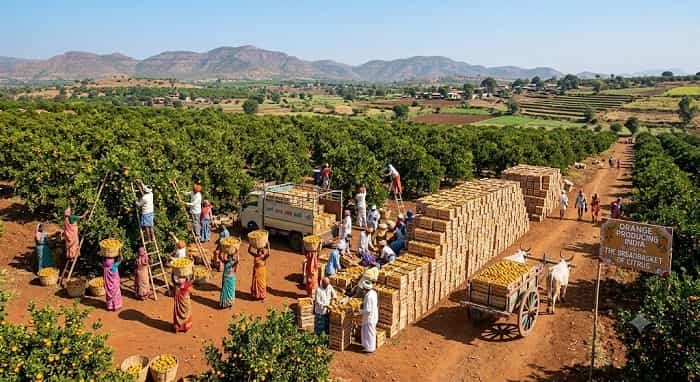
The state’s orange identity is mainly built around Vidarbha, especially Nagpur, Amravati, Wardha, Akola and Buldhana. Nagpur is widely known as the “Orange City,” and Nagpur orange has a strong national identity because of its taste, colour and market demand. The fruit is mainly sold in two seasons — Ambiya and Mrig — which keeps the trade active for a long period. Nagpur orange also received GI recognition, giving it a protected regional identity.
Maharashtra’s strength is not only production but also processing and branding. In 2025, the state extended a scheme for modern orange processing centres at Nagpur, Katol, Kalameshwar, Morshi and Sangrampur. The plan aims to reduce post-harvest losses, which are reported around 25% to 30% in major citrus belts.
The state also attracted a large orange-processing cluster project in Nagpur, planned to source oranges and other fruits from around 21,000 hectares across Nagpur, Wardha and Amravati. This shows why Maharashtra remains India’s strongest orange state by market image, processing push and orchard concentration.
2. Madhya Pradesh
Madhya Pradesh ranks second among India’s top orange producing states.
The state has become a major orange-growing region because of its strong Satpura belt. Chhindwara and Pandhurna are especially important. Areas such as Sausar, Pandhurna, Lodhikheda and nearby belts are known for orange orchards, and many farmers in these regions depend heavily on orange cultivation.
Pandhurna district is famous for its orange fields, and its economy is strongly linked with agriculture. Lodhikheda is also known for oranges, with more than 90% of farmers reported to be involved in orange production.
Madhya Pradesh’s advantage is its location near Maharashtra’s Vidarbha belt. This creates a natural orange-growing zone across the Maharashtra-Madhya Pradesh border. Farmers benefit from similar climate, nursery supply, trading links and market movement towards Nagpur and other fruit mandis.
The state deserves second position because its orange belt is large, specialised and farmer-driven. In many villages, orange is not just one fruit crop; it is the main source of cash income.
3. Rajasthan
Rajasthan stands third among the highest orange producing states in India in 2026.
The state’s orange economy is mainly connected with Jhalawar and the Hadoti region. Bhawani Mandi is especially famous and is known as the “Orange City of Rajasthan.” It is also described as one of India’s major orange markets after Nagpur.
Rajasthan also has strong kinnow production in Sri Ganganagar and Hanumangarh districts. Kinnow is a mandarin-type citrus fruit and is widely treated as part of India’s orange-market chain. In the latest season, Rajasthan’s kinnow output in these districts was expected to rise from about 5 lakh metric tonnes to around 5.2 lakh metric tonnes, although warm weather affected sweetness and market demand.
The state’s strength lies in both traditional orange belts and north Rajasthan’s kinnow orchards. Jhalawar gives Rajasthan a classic orange identity, while Sri Ganganagar and Hanumangarh strengthen its citrus-production scale.
Rajasthan deserves third position because it has strong mandis, recognised orange belts and growing citrus trade in both eastern and northern parts of the state.
4. Punjab
Punjab ranks fourth among India’s leading orange producing states.
Punjab is especially known for kinnow, a high-yield mandarin hybrid. Kinnow is grown widely in the broader Punjab region and has become one of the most important citrus fruits in northern India. It is known for high juice content, attractive colour and strong winter-market demand.
The main kinnow-growing belt of Punjab is around Fazilka, Abohar, Hoshiarpur, Muktsar and nearby regions. Khuian Sarwar in Fazilka district is known for kinnow cultivation and is described as one of the important kinnow-producing areas in Punjab.
Punjab’s citrus economy is strong because of irrigation, commercial farming, organised orchards and good road connectivity to Delhi, Haryana, Rajasthan, Uttar Pradesh and other markets. Kinnow from Punjab is sold fresh, used for juice and also moves into export-linked supply chains.
Punjab deserves fourth position because it has made kinnow a powerful citrus crop. Even though people may call it kinnow more often than orange, it plays a major role in India’s orange-mandarin market.
5. Haryana
Haryana completes the list of the top five orange producing states in India in 2026.
The state’s orange-type citrus strength is again linked mainly with kinnow. Sirsa is the most important district, followed by nearby belts where farmers grow kinnow as a commercial fruit crop. Haryana’s dry climate, irrigation support and market access make kinnow farming useful for farmers in suitable regions.
The scale is significant. Haryana produces around 4.4 lakh metric tonnes of kinnow annually, and Sirsa alone contributes about 55% of the state’s output. The state has also been considering a kinnow juice processing plant in Sirsa to convert B-grade fruit into packaged juice and support farmer income.
Haryana’s place in the top five comes from production volume, processing potential and strong local concentration in Sirsa. Better grading, juice plants and storage can make the state’s kinnow economy more profitable in the coming years.
Final Words
The top five orange producing states in India in 2026 are Maharashtra, Madhya Pradesh, Rajasthan, Punjab and Haryana. Maharashtra leads with Nagpur orange, while Madhya Pradesh and Rajasthan are strong through major orchard belts.
Punjab and Haryana add huge value through kinnow cultivation, which keeps India’s winter citrus markets active. With better processing, cold storage and weather protection, India’s orange economy can become even stronger.