India’s green map looks very different when we count forest by percentage of geographical area instead of total forest area. Madhya Pradesh may have the largest forest cover by area, but when the question is “which state is most covered by forests?”, the spotlight moves to the misty hills of the North East. Here, clouds touch bamboo slopes, villages sit between forested ridges, and rivers cut through thick green valleys. These states may be smaller in land size, but their forest density makes them some of the richest ecological zones in India.
For 2026, the latest official national forest assessment available is the India State of Forest Report 2023, released by the Forest Survey of India in December 2024. FSI defines forest cover as land with tree canopy density of 10% and above and a minimum area of 1 hectare. India’s total forest and tree cover is reported at 8,27,357 sq km, or 25.17% of the country’s geographical area.
1. Mizoram – 85.34% Forest Cover
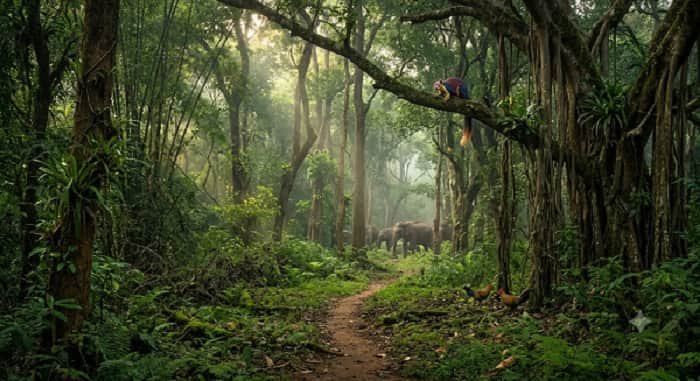
Mizoram ranks first among Indian states with 85.34% of its geographical area under forest cover. The state has around 17,990 sq km of forest cover out of a total geographical area of 21,081 sq km.
Mizoram’s forest strength comes from its hilly terrain, high rainfall, bamboo-rich landscapes, and deep cultural connection with nature. Thick forests cover much of the state’s ridges and valleys, making it one of India’s most naturally green regions. The state is also known for tropical and semi-evergreen forests, bamboo brakes, orchids, medicinal plants, and rich bird life.
However, Mizoram’s forest story also has challenges. Shifting cultivation, road development, settlement expansion, and forest fires affect some areas. Still, compared with other states, Mizoram remains far ahead in forest percentage. Its rank shows how strongly forests shape the state’s geography, economy, climate, and lifestyle.
2. Arunachal Pradesh – 79.33% Forest Cover
Arunachal Pradesh stands second with 79.33% of its geographical area under forest cover. It has about 65,882 sq km of forest cover, which is very large because Arunachal is the biggest state in the North East by area.
The state is often called the “Land of the Dawn-lit Mountains,” and its forests are part of one of the richest biodiversity zones in India. From subtropical forests in lower valleys to temperate and alpine vegetation in higher mountains, Arunachal Pradesh has great ecological variety. Its forests support rare orchids, red pandas, clouded leopards, hornbills, takins, and many tribal communities whose life is closely connected with land and forests.
What makes Arunachal Pradesh special is that it combines both high percentage and large absolute forest area. It is not just green by proportion; it also has one of the largest forest areas in India. This makes it extremely important for biodiversity protection, carbon storage, river systems, and climate balance.
3. Meghalaya – 75.65% Forest Cover
Meghalaya ranks third with 75.65% forest cover. The state has about 16,967 sq km of forest cover out of 22,429 sq km geographical area.
Meghalaya’s name means “abode of clouds,” and the state truly looks like a forested cloudland. Its forests are spread across Khasi, Jaintia, and Garo hills. The state is famous for sacred groves, living root bridges, waterfalls, limestone caves, and rich monsoon forests. Sacred groves are especially important because local communities protect them as traditional conservation zones.
The forest cover of Meghalaya is not only about trees. It supports water sources, soil stability, traditional farming, tourism, and local culture. Cherrapunji and Mawsynram are known for heavy rainfall, but forest cover plays a major role in holding the landscape together. Still, mining, land-use change, and pressure on community forests remain serious issues. Protecting Meghalaya’s forest percentage is important for both ecology and local livelihoods.
4. Manipur – 74.28% Forest Cover
Manipur comes fourth with 74.28% of its geographical area under forest cover. It has around 16,585 sq km of forest cover from a total geographical area of 22,327 sq km.
Manipur’s landscape is a beautiful mix of forested hills and central valley. While the Imphal valley is more settled and cultivated, the surrounding hill districts carry much of the state’s forest wealth. These forests support bamboo, cane, medicinal plants, orchids, birds, mammals, and many local communities.
Manipur is also home to unique ecosystems such as the Loktak Lake region and the famous Keibul Lamjao National Park, known for the endangered Sangai deer. Although the national park is a wetland ecosystem rather than a typical dense forest, it shows the state’s wider ecological importance. In 2026, Manipur remains one of India’s top forest-percentage states, but conservation needs careful attention because land pressure, fires, and shifting cultivation can affect forest quality.
5. Nagaland – 73.72% Forest Cover
Nagaland ranks fifth with 73.72% forest cover. It has about 12,222 sq km of forest cover out of 16,579 sq km geographical area.
Nagaland’s forests are closely linked with its hills, tribes, villages, and traditional community land systems. The state has rich biodiversity, including evergreen forests, bamboo forests, and hill forests that support birds, butterflies, wild plants, and many local food and medicinal resources.
One special feature of Nagaland is community conservation. Many forests are managed by villages and local institutions. In some places, communities have created protected areas for birds and wildlife. The conservation of the Amur falcon in Nagaland is often seen as a strong example of how local participation can change the future of wildlife protection.
Even though Nagaland has a high forest percentage, the state also faces concerns related to jhum cultivation, forest degradation, and development pressure. Its future depends on balancing traditional land use with stronger conservation and sustainable livelihood options.
Final Words
The top five highest forest percentage states in India in 2026 are Mizoram, Arunachal Pradesh, Meghalaya, Manipur, and Nagaland. All five are from the North East, showing how important this region is for India’s ecological security. These states may not always lead in industrial output or population size, but they hold some of India’s most precious green wealth. Their forests protect biodiversity, rivers, soil, climate, and traditional ways of life. In simple words, the North East is one of India’s strongest green shields.