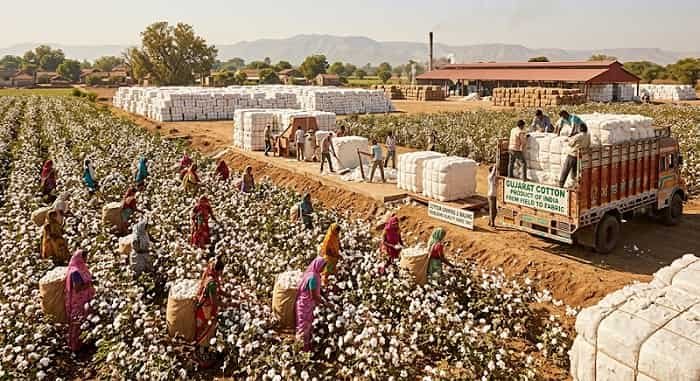
Cotton is the soft white fibre that silently powers India’s textile economy. Before it becomes shirts, sarees, bedsheets, towels, denim, medical cotton, yarn or export-ready fabric, it begins its journey in hot farms, black soil fields and dryland belts. Farmers pick fluffy cotton bolls by hand, traders move them to mandis, ginning mills separate fibre from seed, and then the textile industry turns that fibre into one of India’s most important industrial raw materials.
For this 2026 list, the ranking is based mainly on the latest complete official state-wise cotton production data available in Agricultural Statistics at a Glance 2024–25. The table reports cotton production in million bales, with each bale weighing 170 kg. India’s cotton production was 29.72 million bales in 2024–25, while a later Cotton Association of India estimate for the 2025–26 marketing year placed the crop at around 31.7 million bales after better output in Maharashtra and Telangana.
Now let’s check out the top 5 highest cotton producing states in India in 2026.
1. Maharashtra
Maharashtra is the largest cotton producing state in India in the latest official ranking.
The state produced around 7.37 million bales of cotton in 2024–25, contributing about 24.80% of India’s total cotton production. It also had the largest cotton area among major states, with about 4.12 million hectares under the crop.
Maharashtra deserves the first position because cotton is deeply connected with Vidarbha, Marathwada and parts of Khandesh. Districts such as Yavatmal, Akola, Amravati, Wardha, Nagpur, Jalgaon, Nanded, Hingoli, Parbhani and Aurangabad are important cotton-growing areas.
The state’s cotton farming is largely rain-fed, so monsoon performance plays a big role. When rainfall is good and pest pressure stays under control, Maharashtra’s output can rise strongly. The state also has a wide network of ginning units, textile mills and cotton traders. This gives Maharashtra a powerful place in both raw cotton production and textile-linked supply chains.
2. Gujarat
Gujarat ranks second among India’s highest cotton producing states.
The state produced about 7.16 million bales of cotton in 2024–25, with a national share of around 24.08%. Gujarat’s cotton yield was also strong at 513 kg per hectare, higher than Maharashtra’s yield of 304 kg per hectare.
Gujarat has been one of India’s most famous cotton states for decades. Cotton is grown widely in Saurashtra, Kutch, north Gujarat and central Gujarat. Districts such as Rajkot, Surendranagar, Jamnagar, Amreli, Bhavnagar, Bharuch, Vadodara and Banaskantha are linked with cotton cultivation.
The state’s biggest advantage is its strong textile and industrial ecosystem. Gujarat is not only a major cotton grower; it is also a major centre for ginning, spinning, textile manufacturing and exports. Ahmedabad, Surat and other textile hubs create strong demand for cotton and yarn.
Gujarat also benefits from better irrigation in many belts, strong market access, port connectivity and farmer experience in commercial crops. Even though Maharashtra is slightly ahead in production, Gujarat remains one of India’s most efficient and important cotton states.
3. Telangana
Telangana stands third in cotton production in India.
The state produced around 5.79 million bales of cotton in 2024–25, contributing about 19.47% to India’s total output. Its yield stood at 543 kg per hectare, which was higher than both Maharashtra and Gujarat in the same official table.
Cotton is one of Telangana’s most important commercial crops. It is grown in districts such as Adilabad, Nizamabad, Warangal, Karimnagar, Khammam, Nalgonda, Mahabubnagar and surrounding belts. The state has large black soil and red soil areas where cotton fits well into the kharif season.
Telangana’s rise is important because the state has become a major force in cotton after its formation. Farmers here grow cotton on a large scale, and better seed use, market demand and procurement support have helped the crop remain attractive.
The state is also connected with ginning, pressing and textile activity. In 2025–26, industry estimates also pointed to better output from Telangana, showing that the state remains a strong cotton performer.
4. Karnataka
Karnataka ranks fourth among the highest cotton producing states in India.
The state produced about 2.27 million bales of cotton in 2024–25, with a national share of around 7.65%. Karnataka also recorded a yield of 570 kg per hectare, one of the strongest among the major cotton-producing states.
Cotton cultivation in Karnataka is concentrated in northern districts such as Dharwad, Haveri, Gadag, Ballari, Raichur, Koppal, Vijayapura, Bagalkot and Belagavi. These areas have a long tradition of cotton farming and are also connected with textile and spinning activity.
Karnataka’s strength is productivity. Its cotton area is much smaller than Maharashtra, Gujarat and Telangana, but its yield is strong. This helps the state stay in the top five despite limited acreage.
The state also has a good textile base, especially in spinning, garments and handloom-linked industries. Cotton from Karnataka supports both local textile units and outside markets.
5. Rajasthan
Rajasthan completes the list of the top five cotton producing states in India.
The state produced around 1.79 million bales of cotton in 2024–25, contributing about 6.01% of India’s total cotton production. Rajasthan’s cotton area was about 0.63 million hectares, and its yield was 484 kg per hectare.
Cotton is grown mainly in the irrigated and semi-arid belts of Rajasthan. Important cotton-growing areas include Sri Ganganagar, Hanumangarh, Bikaner, Nagaur, Bhilwara and parts of southern Rajasthan. Canal irrigation plays an important role in supporting cotton cultivation in the north-western districts.
Rajasthan’s cotton story is different from Maharashtra and Telangana because irrigation has a stronger role in many producing belts. The state also has a growing textile and yarn industry, especially around Bhilwara and nearby industrial areas.
Rajasthan may not produce as much cotton as the top three states, but it remains an important producer because of its quality, irrigation support and strong textile-market connection.
Final Words
The top five highest cotton producing states in India in 2026 are Maharashtra, Gujarat, Telangana, Karnataka and Rajasthan. Maharashtra leads because of its huge cotton area, Gujarat remains very close with strong productivity and textile strength, Telangana has become a powerful cotton state, Karnataka performs well with high yield, and Rajasthan completes the top five with its irrigated cotton belts.
Together, these five states form the backbone of India’s cotton economy. Their farms support ginning mills, spinning units, textile factories, garment makers and export supply chains. As India continues to remain one of the world’s biggest cotton producers, better seeds, pest control, irrigation, fair prices and climate protection will decide the future strength of cotton farming.