Coal is still the dark fuel that keeps many parts of India’s economy moving. From thermal power plants and steel factories to cement units, railways, aluminium plants and heavy industries, coal remains one of the most important minerals for the country. Even as solar and wind energy are growing fast, India’s electricity and industrial system still depends heavily on domestic coal.
India produced around 1.05 billion tonnes of coal in FY 2024–25, and the government set a higher production target of 1.15 billion tonnes for FY 2025–26. This shows how strongly India is pushing domestic coal output to reduce imports and support energy security.
For this 2026 list, the ranking is based on coal production strength, major coalfields, active mining companies, recent output trends, reserves and industrial importance. State-wise final FY 2025–26 production data can change after official annual publication, but the production pattern clearly shows these five states as India’s strongest coal producers.
Now let’s check out the top 5 largest coal producing states in India in 2026.
1. Odisha
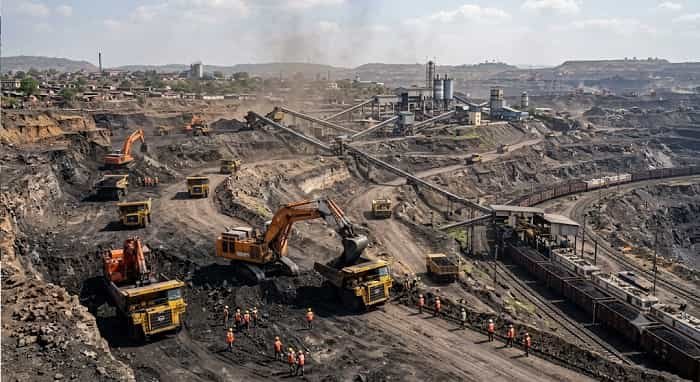
Odisha is the largest coal producing state in India in 2026.
The state has become the biggest force in India’s coal production because of its massive coalfields, especially the Talcher and Ib Valley coalfields. These regions are among the most productive coal belts in the country and supply coal to power plants, aluminium industries, steel plants, sponge iron units and other heavy industries.
Odisha’s coal strength is mainly driven by Mahanadi Coalfields Limited, one of Coal India’s most important subsidiaries. MCL operates coal mines across Odisha, especially in Angul, Jharsuguda and Sundargarh belts. By December 2024, MCL had produced around 203 million tonnes of coal, showing its strong position in India’s coal sector.
The state also has Odisha Coal and Power Limited, which operates coal blocks such as Manoharpur and Dipside of Manoharpur in Sundargarh district. These mines support Odisha’s power and industrial ecosystem.
Odisha deserves the first position because it has huge coal reserves, high-output opencast mines, strong mining infrastructure and direct industrial demand from power, aluminium and steel sectors.
2. Chhattisgarh
Chhattisgarh ranks second among the largest coal producing states in India in 2026.
The state is one of India’s classic coal powerhouses. Its major coal-producing districts include Korba, Raigarh, Surguja, Koriya, Manendragarh-Chirmiri-Bharatpur and parts of Bilaspur region. Korba is especially famous as one of India’s biggest coal and power centres.
Chhattisgarh’s coal economy is strongly connected with South Eastern Coalfields Limited, which is headquartered in Bilaspur. SECL is one of the largest coal-producing companies in India and operates mines across Chhattisgarh and Madhya Pradesh. It has 92 mines in total, including underground and opencast mines.
The state is also home to huge opencast mines such as Gevra, Dipka and Kusmunda in the Korba region. These mines are counted among India’s largest coal mining operations. Chhattisgarh’s coal supports thermal power stations, steel plants, cement factories and many mineral-based industries.
Chhattisgarh deserves second position because it has some of India’s biggest coal mines, strong production history and a deep connection with power generation and steel industries.
3. Jharkhand
Jharkhand stands third among India’s largest coal producing states in 2026.
Jharkhand has one of the oldest and richest coal mining histories in India. Dhanbad is famously known as the Coal Capital of India, and the state has major coalfields such as Jharia, Bokaro, North Karanpura, South Karanpura, Ramgarh, Giridih and Rajmahal.
The state is especially important for both coking and non-coking coal. Coking coal is used in steel making, and Jharkhand’s Jharia coalfield is one of India’s most important coking coal zones. This gives Jharkhand a special place because coal from the state supports not only power plants but also steel industries.
Jharkhand also has the largest coal reserves in India. As per reserve data, Jharkhand holds around 86.217 billion tonnes of coal reserves, followed by Odisha and Chhattisgarh.
Major companies connected with Jharkhand’s coal sector include Bharat Coking Coal Limited, Central Coalfields Limited and Eastern Coalfields Limited. Coal from Jharkhand supports industries in eastern India and beyond.
Jharkhand deserves third position because of its huge reserves, historic mining belts, coking coal importance and strong connection with India’s steel and power sectors.
4. Madhya Pradesh
Madhya Pradesh ranks fourth among India’s top coal producing states in 2026.
The state has important coal belts in Singrauli, Shahdol, Umaria, Anuppur, Betul and Chhindwara regions. Singrauli is the most important name because it is one of India’s biggest coal and thermal power hubs. The region is often called India’s energy capital because of its coal mines and power plants.
Madhya Pradesh’s coal output is supported by Northern Coalfields Limited, South Eastern Coalfields Limited and Western Coalfields Limited. The coal from Singrauli and nearby areas feeds many large thermal power stations in central and northern India.
The state also has strong reserves. Madhya Pradesh holds around 30.217 billion tonnes of coal reserves, making it one of India’s major coal-bearing states.
Madhya Pradesh deserves fourth position because it has a strong production base, large reserves and a powerful coal-to-power connection. Its coalfields are vital for electricity generation in central India.
5. Telangana
Telangana completes the list of the top five largest coal producing states in India in 2026.
Telangana’s coal production is mainly driven by Singareni Collieries Company Limited, one of India’s oldest and most important coal mining companies. SCCL is a joint undertaking of the Telangana government and the central government. It has played a major role in coal mining for more than a century.
The main coal-producing areas of Telangana are found in the Godavari Valley coalfield, especially in districts such as Bhadradri Kothagudem, Mancherial, Peddapalli, Jayashankar Bhupalpally and nearby belts. These mines supply coal to power plants, cement units and industries in Telangana and neighbouring states.
Singareni produced around 70.02 million tonnes of coal in 2023–24, showing why Telangana remains one of India’s major coal-producing states.
Telangana deserves fifth position because it has a stable coal mining company, a strong Godavari Valley coal belt and steady production that supports southern India’s power and industrial demand.
Final Words
India’s coal production is concentrated mainly in eastern, central and south-central India. Odisha and Chhattisgarh lead because of their high-output opencast mines, while Jharkhand remains important for reserves and coking coal. Madhya Pradesh supports India’s power system through the Singrauli belt, and Telangana remains a steady coal producer through Singareni.
Coal may face pressure from renewable energy in the long run, but in 2026 it continues to play a major role in India’s electricity, steel, cement and industrial growth.