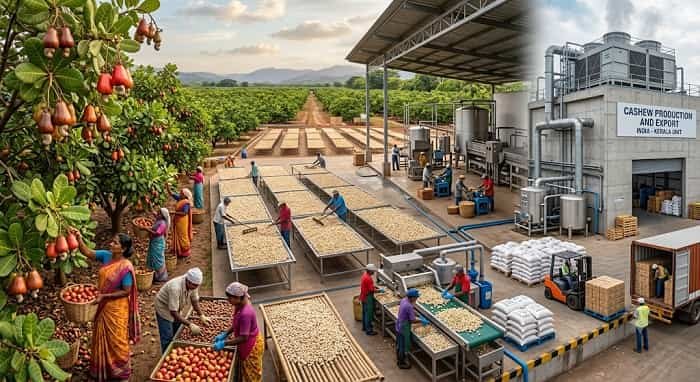
Cashew is one of India’s most valuable plantation crops. It is eaten as a premium dry fruit, used in sweets, bakery products, namkeen, dairy alternatives, gravies, chocolates and export-quality food products. But cashew is not only about the nut. The cashew apple can also be used for juice, jam, vinegar, jaggery and other value-added products.
India has a strong cashew-processing industry, but domestic raw cashew nut production is still not enough for the country’s processing demand. India’s cashew production increased to around 7.95 lakh tonnes in 2023–24, but the industry still depends heavily on imported raw cashew nuts. Another recent update mentioned that India has about 12.1 lakh hectares under cashew cultivation and produces more than 8 lakh tonnes annually.
For this 2026 list, the ranking is based on the latest production pattern, major cashew-growing belts, state-level cultivation strength, processing connection and recent industry updates.
Now let’s check out the top 5 cashew producing states in India in 2026.
1. Maharashtra
Maharashtra is the largest cashew producing state in India in 2026.
The state’s cashew strength is mainly concentrated in the Konkan region. Sindhudurg, Ratnagiri, Raigad, Palghar and parts of Kolhapur are important cashew-growing belts. Among them, Sindhudurg is especially famous for high-quality cashew cultivation.
Maharashtra’s biggest identity in cashew is Vengurla Cashew, a GI-tagged product from Sindhudurg district. Vengurla, Sawantwadi, Kudal, Malvan and nearby areas are known for cashew orchards and traditional processing. Vengurla cashew is linked with Maharashtra’s coastal climate, laterite soil and old cashew-growing culture.
Cashew is important for Konkan farmers because the region has hilly land, lateritic soil and high rainfall. Many farms are not suitable for large-scale cereal crops, but cashew grows well in such conditions. The crop also supports small processing units, women workers, traders and local dry-fruit markets.
Maharashtra deserves the first position because it has a large cultivation area, strong Konkan identity, famous Vengurla varieties, processing strength and good market value. For Maharashtra, cashew is not just a dry fruit crop; it is a key part of the coastal rural economy.
2. Andhra Pradesh
Andhra Pradesh ranks second among India’s top cashew producing states.
The state has a strong cashew belt in north coastal Andhra Pradesh. Srikakulam is the most famous district, especially the Palasa-Kasibugga region, which is one of India’s major cashew-processing centres. Other important areas include Vizianagaram, Parvathipuram Manyam, Alluri Sitharama Raju, Anakapalle and parts of Visakhapatnam.
Andhra Pradesh has around 1.2 lakh hectares under domestic cashew cultivation, but many orchards are ageing and yields are lower than their potential. The Palasa-Kasibugga belt has about 700 processing units, showing how deeply the cashew economy is connected with local employment and trade.
The state’s cashew industry is currently trying to improve productivity. Andhra Pradesh processors have shown interest in high-yielding varieties such as Cambodia’s M23 to overcome low local supply and improve kernel quality.
Andhra Pradesh deserves second position because it has a large coastal cashew belt, strong processing hub, major farmer dependence and high scope for yield improvement. If old plantations are replaced with better varieties, the state can become even stronger in cashew production.
3. Odisha
Odisha stands third among the highest cashew producing states in India.
Cashew is grown widely in Odisha’s coastal, southern and tribal belts. Important cashew-producing districts include Ganjam, Gajapati, Koraput, Rayagada, Nabarangpur, Malkangiri, Kandhamal, Puri, Khordha and Nayagarh. Southern Odisha has particularly good potential because the crop grows well in upland and lateritic soils.
Odisha is one of the major Indian states where cashew is grown on a large scale, and recent national cashew-sector updates specifically mention Odisha among the important cashew-growing states. The presence of Odisha State Cashew Development Corporation also shows the state’s organised focus on this crop; the corporation recently paid dividends for 2022–23 and 2023–24, reflecting its continuing role in the sector.
Cashew is important for Odisha because it suits dry upland areas where many farmers cannot depend only on paddy. It also creates income opportunities for tribal and small farmers. In districts like Gajapati and Koraput, cashew is part of a broader horticulture economy along with mango, pineapple, turmeric and other hill crops.
Odisha deserves third position because it has wide cultivation, suitable climate, strong upland potential and government-backed cashew development. With better processing units and branding, Odisha can get even more value from its cashew crop.
4. Karnataka
Karnataka ranks fourth among India’s leading cashew producing states in 2026.
The state has a long connection with cashew cultivation and processing. Major cashew-growing areas include Dakshina Kannada, Udupi, Uttara Kannada, Shivamogga, Chikkamagaluru, Kodagu, Belagavi and parts of coastal and Malnad Karnataka. Mangaluru is one of India’s historic cashew-processing centres.
Karnataka is especially important for India’s cashew industry because of Mangaluru’s processing tradition. The organised cashew industry in Mangaluru is considered to have started in 1925, and the region has grown into a major processing hub with more than 250 units across Dakshina Kannada and Udupi. Karnataka now processes more than 5 lakh tonnes annually, accounting for about 25% of India’s cashew-processing capacity.
The state is also trying to revive cultivation. Karnataka recently organised a cashew fest in Mangaluru to promote high-yield varieties such as Ullal-1, Ullal-3 and Bhaskara, along with value-added products from cashew apple. The state has also expressed a goal of becoming more self-reliant in cashew production.
Karnataka deserves fourth position because it has both cultivation and a powerful processing ecosystem. Its challenge is to increase local raw nut production so that processors do not depend too heavily on imported cashew.
5. Tamil Nadu
Tamil Nadu completes the list of the top five cashew producing states in India in 2026.
The state’s cashew belt is mainly concentrated in Cuddalore, Ariyalur, Perambalur, Pudukottai, Thanjavur, Villupuram, Sivaganga and parts of southern and central Tamil Nadu. Cuddalore, especially the Panruti region, is one of the most famous cashew centres in the state.
Tamil Nadu has recently taken a major policy step by setting up the Tamil Nadu Cashew Board. The board was created to improve cashew cultivation, promote high-yield varieties, support farmers and workers, improve storage and processing, and reduce dependence on imported raw nuts. It was announced with a ₹10 crore allocation and is headquartered in Cuddalore.
Tamil Nadu is also counted as the fifth-largest state in cashew cultivation in India, and its cashew apple potential is very high. A recent report noted that large quantities of cashew apples in districts like Cuddalore are wasted, creating scope for juice, feni-like drinks and other value-added products.
Tamil Nadu deserves fifth position because it has a strong traditional cashew belt, active processing pockets, government support and good future potential in value addition.
Final Words
The top five cashew producing states in India in 2026 are Maharashtra, Andhra Pradesh, Odisha, Karnataka and Tamil Nadu. Maharashtra leads through its Konkan belt, while Andhra Pradesh, Odisha and Karnataka have strong production and processing strength.
Cashew farming can become more profitable with high-yield varieties, old orchard rejuvenation, better prices, farmer groups, local processing and smart use of cashew apple. This crop has strong potential to support farmers, workers and India’s dry-fruit economy.