Salt is one of the most basic but most essential minerals in daily life. It enters every kitchen, but its use goes far beyond food. Salt is needed in chemicals, soda ash, textiles, leather, water treatment, fisheries, cattle feed, pharmaceuticals and several industrial processes. From salt pans under the hot sun to iodised salt factories and chemical plants, this simple white crystal supports a large rural and industrial economy.
India’s salt production is mainly concentrated in western and southern coastal belts, along with inland saline lakes and desert brine areas. For this 2026 list, the ranking is based on salt-producing strength, traditional salt belts, industrial salt use, processing capacity and recent updates from major producing regions.
Now let’s check out the top 5 highest salt producing states in India in 2026.
1. Gujarat
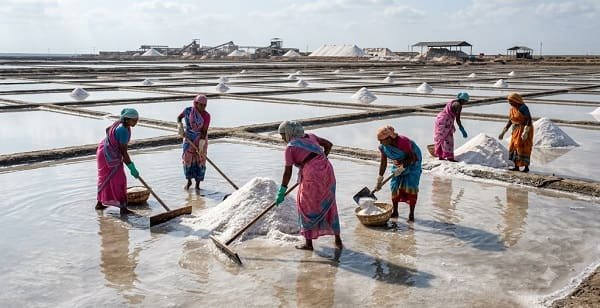
The state dominates India’s salt economy by a huge margin. Gujarat has the country’s longest coastline, vast saline desert areas and strong industrial demand. Its salt production is mainly concentrated in Kutch, Saurashtra and coastal Gujarat. Important salt-producing regions include Kutch, Surendranagar, Jamnagar, Bhavnagar, Bharuch, Rajkot and parts of the Little Rann of Kutch.
Kutch is the real heart of Gujarat’s salt industry. The Little Rann of Kutch has a long history of salt production, and the Agariya community has been working in salt pans for generations. Reports based on Salt Commission references mention that Gujarat contributes nearly three-fourths of India’s salt production, mainly from Kutch and Saurashtra.
Gujarat’s importance is not limited to edible salt. The state is also a major industrial salt supplier. Its salt feeds soda ash, chlor-alkali, chemicals, textiles and other industries. Gujarat is also known for large salt-linked companies and chemical hubs around Mithapur, Kutch, Jamnagar, Dahej and other industrial belts.
The state deserves the first position because it combines natural salt pans, desert brine, coastal evaporation, industrial demand, port connectivity and generations of salt-making experience. No other Indian state comes close to Gujarat’s scale.
2. Rajasthan
Unlike Gujarat or Tamil Nadu, Rajasthan is not a coastal salt state. Its strength comes from inland saline lakes and desert brine resources. The most famous salt-producing region is Sambhar Salt Lake, which is India’s largest inland saline lake. Nawa, Didwana, Kuchaman, Phalodi, Pachpadra and parts of Nagaur and Jodhpur are also important salt belts.
Sambhar Salt Lake has historic importance in India’s salt industry. It produces salt through evaporation of brine and has long been connected with Sambhar Salts Ltd and private salt producers. The lake is described as the source of most of Rajasthan’s salt production.
Rajasthan’s salt economy is also linked with its mineral-rich desert landscape. The state is reported to contribute around one-tenth of India’s salt, which keeps it among the most important salt-producing states.
Rajasthan deserves second position because it has strong inland salt resources, old salt lakes, desert brine production and a long salt-making tradition. Its salt industry may not match Gujarat’s giant scale, but it remains highly important in India’s total production map.
3. Tamil Nadu
The state has one of India’s oldest and strongest coastal salt industries. Its salt production is mainly concentrated in Thoothukudi, Ramanathapuram, Nagapattinam, Vedaranyam, Marakkanam and nearby coastal belts. Thoothukudi is the biggest salt centre of the state and one of the most famous salt-producing districts in India.
Tamil Nadu has traditionally been India’s second-largest salt producer after Gujarat, and Thoothukudi district alone contributes a major share of Tamil Nadu’s salt output. The district is reported to account for about 70% of the state’s salt production and nearly 30% of India’s salt production in older regional references.
However, Tamil Nadu’s salt sector was hit badly by weather in the 2025–26 season. Cyclone Ditwah damaged nearly 20,000 acres of salt pans in Tuticorin district and pushed Tamil Nadu to third place in national salt production rankings, according to local industry reporting.
Tamil Nadu still deserves a top-three position because it has strong coastal salt pans, skilled labour, edible salt processing, industrial salt production and new investment. Tata Chemicals announced a ₹515 crore greenfield iodised vacuum salt dried facility at Valinokkam in Ramanathapuram district, showing continued confidence in Tamil Nadu’s salt sector.
4. Andhra Pradesh
The state has a long coastline and several salt-producing belts along the Bay of Bengal. Salt is produced in coastal districts such as Nellore, Prakasam, Guntur, Krishna, Kakinada, East Godavari and Srikakulam. The crop depends heavily on dry weather, seawater evaporation and suitable coastal land.
Andhra Pradesh’s salt industry is smaller than Gujarat, Rajasthan and Tamil Nadu, but it still plays an important role in India’s salt supply chain. Many small and medium salt producers operate in coastal belts, producing both edible and industrial salt. The state’s coastal geography gives it a natural advantage for solar salt production.
The salt sector here is closely linked with labour-intensive work. Salt pan workers prepare beds, pump brine, control crystallisation, harvest salt and move it for washing, grading and transport. Like other coastal salt states, Andhra Pradesh’s production is vulnerable to cyclones, heavy rain and flooding.
Andhra Pradesh deserves fourth position because it has a long coastline, established salt pans and a steady role in eastern and southern India’s salt supply. Better mechanisation, worker welfare and weather-resilient infrastructure can make the sector stronger.
5. Maharashtra
The state’s salt production is mainly found along the coastal belt, especially around Mumbai Metropolitan Region, Thane, Palghar, Raigad and Ratnagiri. Salt pans have existed for generations in places such as Bhayandar, Vasai, Palghar, Pen and Uran. Pen in Raigad district is also known for salt cultivation by Aagri and Koli communities.
Maharashtra’s salt sector is smaller than Gujarat or Tamil Nadu, but it has historical and regional importance. Many old salt pans near Mumbai and Thane were once major suppliers, though urbanisation has reduced salt-pan land in several areas. Still, traditional salt-making communities continue to work in selected coastal belts.
The state also has industrial demand because of its large chemical, textile, pharmaceutical and food-processing sectors. Local salt production supports regional markets, while industrial users also depend on supply from Gujarat and other states.
Maharashtra deserves fifth position because it has an old coastal salt-making tradition, active salt pockets and strong nearby markets. Its future will depend on protecting salt-pan areas, supporting traditional workers and balancing urban growth with coastal livelihoods.
Final Words
The top five salt producing states in India in 2026 are Gujarat, Rajasthan, Tamil Nadu, Andhra Pradesh and Maharashtra. Gujarat is the clear leader, while Rajasthan and Tamil Nadu form the next strong group.
Salt may look simple, but it supports food, health, chemicals, industries and thousands of salt-pan workers. Better infrastructure, weather protection and worker welfare can make India’s salt industry stronger.