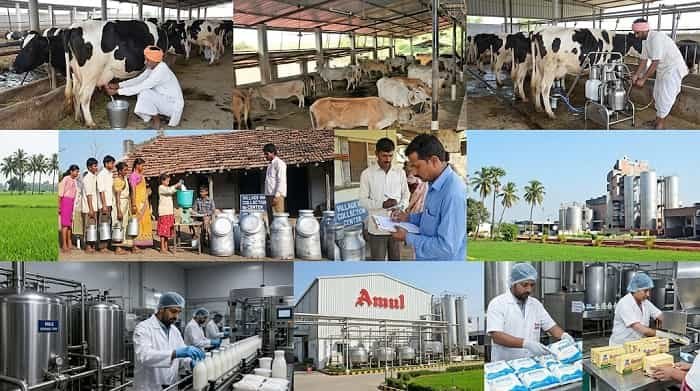
Milk is the white river of India’s rural economy. Every morning, before cities fully wake up, small farmers, dairy cooperatives, private milk collectors and chilling centres begin their work. Steel cans move from village lanes to collection points, tankers roll towards processing plants, and milk becomes curd, paneer, ghee, butter, sweets, ice cream and packaged dairy products. In India, milk is not only food. It is income, nutrition, employment and a daily habit for millions of families.
India’s total milk production reached nearly 248 million tonnes in 2024–25, up from about 239 million tonnes in 2023–24, according to the Basic Animal Husbandry Statistics 2025 update reported after National Milk Day. India also remains the world’s largest milk producer.
Now let’s check out the top 5 highest milk producing states in India in 2026.
1. Uttar Pradesh
Uttar Pradesh is the largest milk producing state in India in 2026.
The state’s milk production increased from around 277 lakh tonnes in 2016–17 to about 388 lakh tonnes in 2024–25, keeping Uttar Pradesh at the top of India’s dairy map. Recent reports place its contribution at roughly 16% of India’s total milk output.
Uttar Pradesh deserves the first position because it has a huge livestock population, a large rural base and strong demand for milk and milk products. Dairy farming is common across western, central and eastern Uttar Pradesh. Districts such as Meerut, Bulandshahr, Agra, Aligarh, Muzaffarnagar, Bareilly and Azamgarh are important milk-producing belts.
The state’s dairy strength comes mainly from small and medium farmers. For many rural households, milk is a regular source of cash income. Even if crop income comes seasonally, milk can bring daily or weekly earnings. This makes dairy very important for village families.
Uttar Pradesh also has a large consumer market. Cities such as Lucknow, Kanpur, Ghaziabad, Noida, Varanasi and Prayagraj create huge demand for liquid milk, curd, paneer, sweets and other dairy items. This combination of production and consumption makes Uttar Pradesh India’s strongest dairy state.
2. Rajasthan
Rajasthan ranks second among the highest milk producing states in India.
The state has become one of India’s biggest dairy powers because of its strong cattle and buffalo population, large rural area and well-developed cooperative dairy network. Rajasthan usually contributes around 14–15% of India’s milk production, placing it very close behind Uttar Pradesh in the national ranking.
Rajasthan’s dairy belt is spread across districts such as Jaipur, Alwar, Bharatpur, Ajmer, Bhilwara, Bikaner, Jodhpur, Nagaur and Udaipur. The state’s semi-arid climate makes crop farming difficult in many regions, so animal husbandry becomes a very important livelihood option.
One reason Rajasthan is strong in milk production is its traditional dependence on livestock. Cows, buffaloes, goats and camels are part of the rural economy. Milk, ghee, buttermilk and curd are also deeply connected with the food culture of the state.
The Rajasthan government has also been pushing dairy infrastructure. In 2025, a ₹1,000 crore dairy infrastructure fund was approved to modernise cooperative dairies, increase processing capacity, set up new plants and improve cattle-feed and milk-powder capacity.
This shows that Rajasthan is not only a traditional milk producer but also a state preparing for a stronger dairy future.
3. Madhya Pradesh
Madhya Pradesh stands third in India’s milk production ranking.
The state has grown rapidly in the dairy sector because of its large rural population, expanding animal husbandry activity and central location. Madhya Pradesh is not only an agricultural state; dairy has become an important additional income source for farmers.
Important milk-producing regions include Indore, Ujjain, Bhopal, Gwalior, Jabalpur, Sagar, Ratlam, Dewas and nearby districts. The Malwa and central regions of the state have strong dairy activity because farmers combine crop farming with cattle and buffalo rearing.
Madhya Pradesh benefits from its location. Milk and dairy products from the state can move towards Maharashtra, Gujarat, Rajasthan, Uttar Pradesh and Chhattisgarh. This gives the state a market advantage.
Another reason for Madhya Pradesh’s rise is the growth of organised dairies, milk unions and private processing units. As cold chains and chilling centres improve, more farmers can sell milk regularly instead of depending only on local consumption.
In 2026, Madhya Pradesh remains one of India’s strongest milk-producing states because it combines livestock strength, farming families and a growing dairy market.
4. Gujarat
Gujarat ranks fourth among India’s highest milk producing states in 2026.
Gujarat’s name is almost inseparable from India’s dairy revolution. The Amul cooperative model from Anand changed the country’s dairy story and became the base of India’s White Revolution. Even today, Gujarat remains one of the most organised and respected dairy states in India.
Milk production in Gujarat is supported by strong cooperative networks, village-level milk collection systems and powerful dairy unions. Banaskantha, Mehsana, Anand, Sabarkantha, Kheda and Panchmahal are among the important dairy belts. North Gujarat is especially known for large-scale dairy activity, and Banas Dairy is one of the strongest cooperative dairy institutions in the country.
The state’s biggest strength is organisation. Farmers are connected to collection centres, quality testing, chilling systems, processing plants and branded marketing. This gives Gujarat a special place in the dairy industry even when some other states produce more milk in total volume.
Gujarat’s dairy sector also supports value-added products such as butter, ghee, cheese, milk powder, paneer, flavoured milk and ice cream. This makes the state important not only for raw milk production but also for dairy processing and branding.
5. Maharashtra
Maharashtra completes the list of the top five highest milk producing states in India.
The state produced about 166.26 lakh metric tonnes of milk in 2024–25, rising from 101.52 lakh metric tonnes in 2015–16. This means Maharashtra’s milk production grew by around 63.8% over ten years.
Maharashtra’s dairy sector is spread across western Maharashtra, Marathwada, Vidarbha and northern parts of the state. Districts such as Pune, Ahmednagar, Solapur, Kolhapur, Sangli, Nashik, Jalgaon, Nagpur and Satara are important for dairy activity.
Western Maharashtra has a particularly strong cooperative culture. Sugar cooperatives, dairy societies and rural institutions have helped farmers build better market access. Milk production also supports women, small farmers and landless families because dairy can be managed along with farming or household work.
The state has a large urban market too. Mumbai, Pune, Nagpur, Nashik and other cities create steady demand for packaged milk, curd, paneer, ghee and other dairy products. Maharashtra also had 68 milk processing plants and 44 chilling centres by March 2025, showing its strong dairy infrastructure.
Final Words
The top five highest milk producing states in India in 2026 are Uttar Pradesh, Rajasthan, Madhya Pradesh, Gujarat and Maharashtra. Uttar Pradesh leads the country with the highest milk output, Rajasthan remains a strong second, Madhya Pradesh is rising steadily, Gujarat continues to represent India’s cooperative dairy strength, and Maharashtra completes the top five with strong growth and processing capacity.
Together, these states form the backbone of India’s dairy economy. They support farmers, cooperatives, private dairies, food companies and millions of consumers who depend on milk every day. As India’s dairy demand keeps rising, better cattle health, breed improvement, feed quality, chilling centres and farmer-friendly pricing will decide the future of milk production.