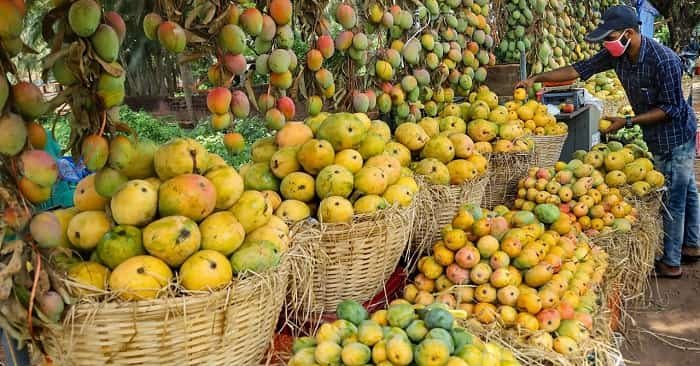
Mango is the golden crown of Indian summer. The season begins with tiny blossoms on old trees, then the smell of raw mango moves through village lanes, and finally baskets of ripe fruit reach markets, railway stations, fruit shops and homes. From Dussehri and Langra to Banganapalli, Malda, Kesar and Totapuri, India’s mango map is full of flavour, climate, soil and local pride.
Uttar Pradesh has been confirmed as India’s leading mango producer in the 2025–26 second advance estimates, while APEDA-linked data lists Uttar Pradesh, Andhra Pradesh, Bihar, Karnataka, Gujarat, Madhya Pradesh and Tamil Nadu as the major mango-growing states. India remains the world’s largest mango producer, and recent market data places India’s mango output at around 28 million metric tonnes in 2024–25.
Now let’s check out the top 5 highest mango producing states in India in 2026.
1. Uttar Pradesh
Uttar Pradesh is the largest mango producing state in India in 2026.
The state holds the first position because of its huge mango belt, high productivity and strong traditional orchards. APEDA-linked data says Uttar Pradesh ranked first in mango production in 2023–24 with a share of 26.75%, and the 2025–26 second advance estimates again place UP as the top mango-producing state.
Uttar Pradesh is famous for varieties such as Dussehri, Langra, Chausa, Safeda and Amrapali. The Malihabad belt near Lucknow is one of the most famous mango regions in India. Saharanpur, Meerut, Amroha, Hardoi, Sitapur, Unnao, Varanasi and nearby belts also contribute to the state’s mango production.
UP deserves the first position not only because of volume but also because of brand value. Dussehri mango from Malihabad has national recognition, while Langra from Varanasi is loved for its strong aroma and taste. The state also has a large domestic market, so most mangoes are consumed within India. With better grading, packaging, processing and export support, Uttar Pradesh can become even stronger in premium mango trade.
2. Andhra Pradesh
Andhra Pradesh ranks second among India’s highest mango producing states.
The state is one of India’s biggest mango-growing regions, with around 3.75 lakh hectares under mango cultivation and an estimated annual production of around 40 to 50 lakh tonnes, according to state horticulture officials.
Andhra Pradesh is especially famous for Banganapalli, also called Banginapalli or Benishan. This variety is popular because of its large size, smooth skin, sweet pulp and export value. Other important varieties include Chinna Rasalu, Pedda Rasalu, Totapuri, Neelam and Suvarnarekha.
Major mango-growing districts include Chittoor, Tirupati, Eluru, Krishna, Annamayya, Vizianagaram and parts of Rayalaseema and coastal Andhra. The state is also important for mango pulp and processing. Totapuri mangoes are widely used by pulp industries, while Banganapalli is valued as a table fruit.
Andhra Pradesh has a natural advantage because of its climate, irrigation support and commercial horticulture culture. The state government has also been focusing on export-quality mango production, fruit-cover technology and better farmer training. This keeps Andhra Pradesh firmly in the top two.
3. Bihar
Bihar stands third among India’s top mango producing states.
The state cultivates mangoes on around 1.65 lakh hectares and produces about 15.8 lakh metric tonnes, according to Bihar’s horticulture department-linked reporting. It also exported mangoes and mango pulp in 2024–25, showing rising market interest beyond local consumption.
Bihar is famous for varieties such as Malda, Zardalu, Langra, Gulabkhas, Fazli, Dussehri and Chausa. Bhagalpur’s Zardalu mango is especially respected and has strong identity value. Muzaffarpur, Darbhanga, Samastipur, Bhagalpur, Patna, Vaishali, East Champaran and West Champaran are among the important mango-growing regions.
Bihar’s mango story is deeply linked with old orchards and traditional farming. Many mango trees in the state are decades old and still produce good fruit. The state is also working on orchard rejuvenation, top-working and intercropping so that old orchards can become more productive.
Bihar may not always get the same national attention as UP or Andhra Pradesh, but its mango diversity is very rich. With better cold chain, branding and export handling, Bihar can become a much stronger mango state in the coming years.
4. Karnataka
Karnataka ranks fourth in India’s mango production map.
The state is one of South India’s most important mango producers and is known for both table mangoes and processing varieties. APEDA-linked data lists Karnataka among India’s major mango-growing states, and the Centre also approved procurement support for up to 2.5 lakh metric tonnes of mangoes from Karnataka during the 2025–26 season because of surplus production and price pressure.
Karnataka grows varieties such as Totapuri, Alphonso, Badami, Mallika, Raspuri, Neelam and Kesar. Kolar, Ramanagara, Chikkaballapur, Bengaluru Rural, Dharwad, Belagavi, Koppal and Mysuru are important mango belts.
Kolar is one of the best-known mango districts in Karnataka. Totapuri mango from the state is widely used in pulp and processing industries, while Badami and Raspuri are popular among consumers. Karnataka also has good links with Bengaluru’s large fruit market, processing units and export channels.
The state’s mango farmers face weather and price challenges, but the large production base keeps Karnataka inside the top five. Better market intervention, pulp processing and direct farmer sales can further improve returns.
5. Gujarat
Gujarat completes the list of the top five highest mango producing states in India.
Mango is a major horticulture crop in Gujarat. In 2024–25, the state had more than 1.77 lakh hectares under mango cultivation, accounting for about 37% of Gujarat’s total horticulture area. Major mango-growing districts include Valsad, Navsari, Gir Somnath, Kutch and Surat.
Gujarat is best known for Kesar mango, especially Gir Kesar from the Saurashtra region. The state also grows Alphonso, Rajapuri, Totapuri and Sonpari varieties. Kesar mango has strong demand because of its saffron-coloured pulp, rich taste and premium image.
Gujarat’s advantage is not only farming but also market strength. The state has good roads, ports, irradiation facilities and export support. Kesar mangoes from Gujarat are supplied to domestic premium markets and also exported in limited but valuable quantities.
Although Gujarat’s total production is lower than Uttar Pradesh and Andhra Pradesh, its mango branding is very strong. This makes Gujarat one of the most important mango states in India.
Final Words
The top five highest mango producing states in India in 2026 are Uttar Pradesh, Andhra Pradesh, Bihar, Karnataka and Gujarat. Uttar Pradesh leads the country with its huge mango belt and famous Dussehri-Langra identity. Andhra Pradesh is a giant in Banganapalli and mango pulp. Bihar adds rich traditional varieties, Karnataka supports both table and processing mangoes, and Gujarat stands out through its premium Kesar mango.
Together, these five states shape India’s mango economy. They feed domestic markets, support farmers, supply processing units and keep India’s identity as the world’s mango capital alive.