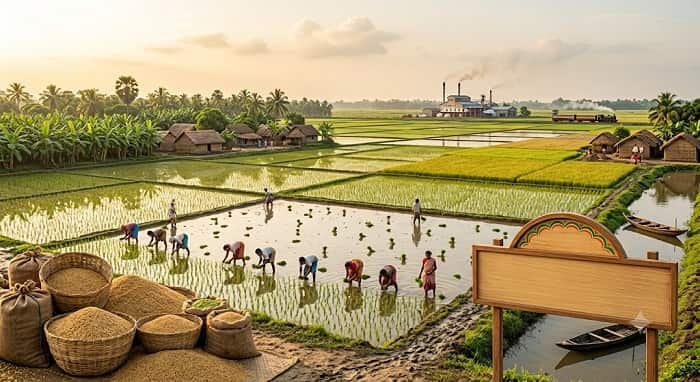
Rice is the grain that keeps India’s food bowl alive. From the flooded paddy fields of Uttar Pradesh to the canal-fed farms of Telangana and Punjab, from Bengal’s green delta to Chhattisgarh’s rice-rich plains, every harvest season turns rural India into a moving picture of water, soil, labour and tradition. Paddy fields shine like mirrors during monsoon, turn deep green as the crop grows, and finally become golden before reaching mills, markets and millions of homes.
For this 2026 list, the ranking is based on the latest complete official state-wise rice production data available in Agricultural Statistics at a Glance 2024–25. The table shows India’s rice production at 150.18 million tonnes in 2024–25, with states arranged by their share in national production.
Now let’s check out the top 5 highest rice producing states in India in 2026.
1. Uttar Pradesh
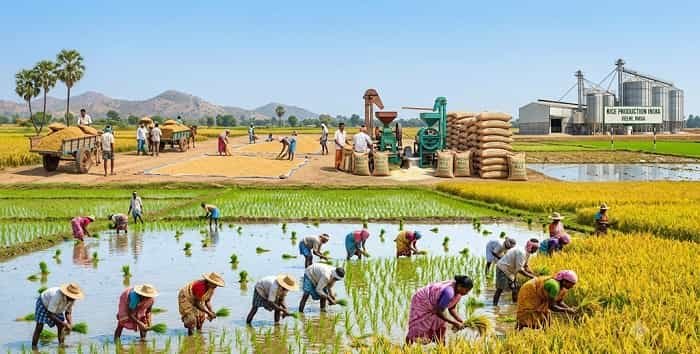
Uttar Pradesh is the largest rice producing state in India in the latest official ranking. The state produced around 20.76 million tonnes of rice in 2024–25, contributing 13.82% to India’s total rice production.
Uttar Pradesh deserves the first position because it has a huge agricultural base, fertile Gangetic plains and wide paddy cultivation across eastern, central and western parts of the state. Districts in eastern Uttar Pradesh are especially important for rice farming because they receive better monsoon support and have suitable alluvial soil.
The state’s strength is scale. Even if its yield is lower than Punjab and Telangana, its large rice area helps it produce the highest quantity. Rice is a major kharif crop here and is grown by millions of farmers. For India’s food security, Uttar Pradesh plays a very important role because it produces both rice and wheat in massive quantities.
2. Telangana
Telangana ranks second among India’s highest rice producing states. The state produced about 17.45 million tonnes of rice in 2024–25 and contributed 11.62% to India’s total production.
Telangana has become one of India’s fastest-rising rice states. Earlier, it was not always placed this high in traditional rice rankings, but irrigation expansion, paddy procurement support and strong farmer participation have pushed the state into the top group. The official table also shows Telangana with a high rice yield of 3,627 kg per hectare in 2024–25.
The state’s rice growth is mainly linked with irrigated farming. Areas connected with major irrigation projects, tanks and canal systems have helped farmers grow paddy on a larger scale. Telangana’s rise shows how irrigation and government procurement can change the position of a state in India’s rice economy.
3. West Bengal
West Bengal stands third in rice production. The state produced around 16.02 million tonnes of rice in 2024–25, with a national share of 10.67%.
West Bengal has always been one of India’s most famous rice-growing states. Rice is not only a crop here; it is part of daily food, rural life and local culture. The state’s fertile deltaic plains, river systems, humid climate and long tradition of paddy farming make it naturally suitable for rice cultivation.
Burdwan, Hooghly, Nadia, Murshidabad, Bankura, Birbhum, North 24 Parganas, South 24 Parganas and several other districts contribute to the rice basket of West Bengal. The state grows rice in different seasons, including aus, aman and boro. This multi-season rice cultivation keeps West Bengal among India’s strongest rice producers.
4. Punjab
Punjab ranks fourth in India’s rice production list. The state produced about 14.36 million tonnes of rice in 2024–25 and contributed 9.56% to the national total.
Punjab’s importance comes from productivity. The state had a very high rice yield of 4,428 kg per hectare in 2024–25, much higher than the national average of 2,929 kg per hectare.
Punjab is known as one of India’s strongest grain-producing states because of assured irrigation, mechanised farming, high-yielding varieties, strong procurement systems and experienced farmers. Paddy is grown widely in districts such as Ludhiana, Patiala, Sangrur, Moga, Firozpur, Amritsar and Gurdaspur.
At the same time, Punjab’s rice story also has a serious concern. Paddy cultivation uses a lot of water, and the state has been facing groundwater stress. So, while Punjab remains a top rice producer, crop diversification and water-saving farming methods are becoming more important for its future.
5. Chhattisgarh
Chhattisgarh completes the top five largest rice producing states in India. The state produced around 10.37 million tonnes of rice in 2024–25, contributing 6.90% to India’s total rice production.
Chhattisgarh is often called the “Rice Bowl of India,” and this title fits its farming identity very well. Rice is the main crop of the state and is grown across large parts of the plains. Districts such as Raipur, Durg, Bilaspur, Janjgir-Champa, Rajnandgaon, Mahasamund and surrounding areas are important rice-growing belts.
The state’s rice farming depends strongly on monsoon, tanks, canals and traditional paddy systems. Chhattisgarh also has a rich diversity of rice varieties, including traditional local varieties grown by tribal and rural communities. Its position in the top five shows that rice is not just an agricultural crop here but a central part of the state’s economy and food culture.
Final Words
The top five highest rice producing states in India in 2026 are Uttar Pradesh, Telangana, West Bengal, Punjab and Chhattisgarh. Uttar Pradesh leads because of its huge farming area, Telangana has risen strongly with irrigation and procurement support, West Bengal remains a traditional rice giant, Punjab stands out for high productivity, and Chhattisgarh continues to justify its identity as India’s rice bowl.
Together, these five states produce a major share of India’s rice and play a key role in feeding the country. As demand keeps rising, better irrigation, climate-resilient seeds, soil management, storage and farmer support will decide the future strength of India’s rice production.