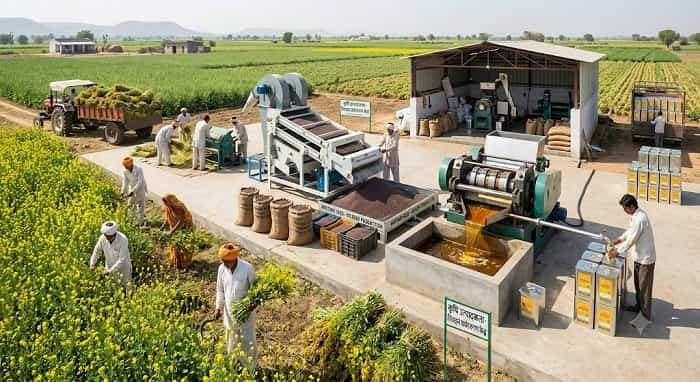
Mustard is one of those crops that gives colour to Indian winter fields. When the yellow flowers spread across villages, the crop is not only adding beauty to the land; it is also preparing seed for cooking oil, oil mills, cattle feed, local mandis and farmer income. Rapeseed-mustard is one of India’s most important rabi oilseed crops, and its role becomes even more important because India still depends heavily on imported edible oils.
For this 2026 list, the ranking is based on the latest available mustard production pattern, major growing belts, acreage strength, recent crop-season estimates and the long-term importance of each state in India’s oilseed economy. India’s mustard output for the rabi 2025–26 season is estimated at about 119.4 lakh tonnes, with Rajasthan alone remaining the biggest contributor.
Now let’s check out the top 5 mustard rapeseed producing states in India in 2026.
1. Rajasthan
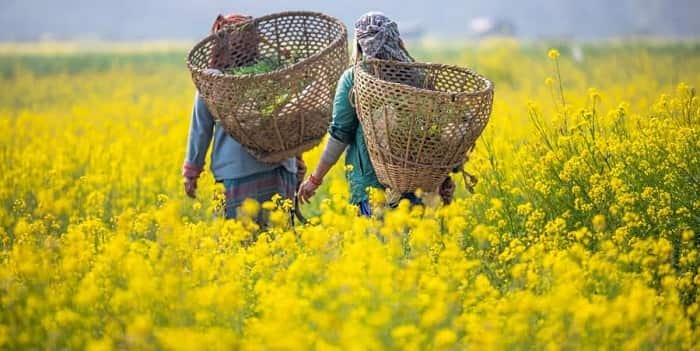
Rajasthan is the largest mustard rapeseed producing state in India in 2026.
The state is the real heart of India’s mustard economy. Large parts of Rajasthan’s rabi fields are covered with mustard, especially in districts such as Bharatpur, Alwar, Sri Ganganagar, Hanumangarh, Jaipur, Tonk, Sawai Madhopur, Kota, Baran and Churu. The crop suits the state’s dry winter climate and is widely grown by farmers as a major cash crop.
Rajasthan’s dominance is very strong. For the 2025–26 rabi season, the state’s mustard production is estimated at about 53.9 lakh tonnes, compared with around 52 lakh tonnes in the previous year. Its acreage also increased from 34.74 lakh hectares to 35.77 lakh hectares.
The state deserves the first position because it combines huge area, farmer experience, strong mandi arrivals, oil mill demand and suitable agro-climatic conditions. Mustard is also deeply connected with Rajasthan’s rural economy because it gives farmers a valuable rabi crop option beyond wheat and gram.
2. Madhya Pradesh
Madhya Pradesh ranks second among India’s top mustard rapeseed producing states.
The state has become a strong oilseed producer because of its large agricultural base and wide rabi crop area. Mustard is grown in many parts of northern and western Madhya Pradesh, especially in districts such as Morena, Bhind, Gwalior, Sheopur, Shivpuri, Neemuch, Mandsaur, Ratlam and parts of the Chambal and Malwa belts.
Madhya Pradesh’s mustard strength comes from its mixed farming system. Farmers here grow soybean in kharif and wheat, gram or mustard in rabi. In suitable dry and irrigated areas, mustard becomes a useful crop because it requires comparatively less water than wheat and gives oilseed value.
The state’s position is important because it helps India diversify mustard production beyond Rajasthan and Haryana. Madhya Pradesh is also one of the states watched closely during heat-risk periods, as unusually high temperatures can affect rapeseed and wheat crops in the main producing belt.
With better seed varieties, irrigation support and oilseed-focused farming, Madhya Pradesh remains one of the strongest mustard rapeseed producing states in India.
3. Haryana
Haryana stands third among the highest mustard rapeseed producing states in India.
The state is small in area compared with Rajasthan and Madhya Pradesh, but its farming system is highly productive. Mustard is grown mainly in southern and western Haryana, especially in districts such as Hisar, Bhiwani, Mahendragarh, Rewari, Sirsa, Fatehabad, Jhajjar and parts of Gurugram and Charkhi Dadri.
Haryana’s biggest strength is irrigation, scientific farming and improved seed adoption. Farmers here are familiar with rabi crops, and mustard fits well in areas where wheat is not always the best choice. It is also important for edible oil production and local oil mills.
The state is also active in mustard research. In 2026, Haryana Agricultural University developed its first hybrid mustard variety, RHH-2101, with an average yield potential of 28–30 quintals per hectare and about 40% oil content. This variety is expected to benefit farmers in Haryana, Punjab, Delhi, Jammu and northern Rajasthan.
Haryana remains in the top three because of its high productivity, strong research support and long connection with rapeseed-mustard cultivation.
4. Uttar Pradesh
Uttar Pradesh holds the fourth position among India’s mustard rapeseed producing states in 2026.
The state has a wide farming base and mustard is grown in many western, central and eastern districts. Important mustard-growing belts include Agra, Mathura, Aligarh, Etah, Mainpuri, Kanpur, Unnao, Hardoi, Sitapur, Bareilly, Shahjahanpur and parts of Bundelkhand. In many areas, mustard is grown along with wheat, gram, lentil and other rabi crops.
Uttar Pradesh’s advantage is its large agricultural land and huge domestic demand for mustard oil. In many households, mustard oil is used for cooking, pickles and traditional food preparation. This creates a strong local market for farmers and traders.
The state is also seeing varietal improvement. A new mustard variety named Govardhan was notified in late 2025 for cultivation and is suitable for late sowing conditions across Uttar Pradesh. It has about 39.6% oil content and matures in around 120–125 days.
Uttar Pradesh deserves its place in the top five because of its wide cultivation base, large farmer population, strong local consumption and growing attention to improved mustard varieties.
5. Gujarat
Gujarat completes the list of the top five mustard rapeseed producing states in India.
The state is better known for groundnut, cotton and castor, but mustard also has an important place in selected rabi belts. North Gujarat and parts of Saurashtra are especially relevant for mustard cultivation. Districts such as Banaskantha, Patan, Mehsana, Sabarkantha and nearby regions have suitable conditions for rapeseed-mustard farming.
Gujarat’s mustard sector benefits from a strong oilseed culture. The state has good trading networks, oil mills, agri-markets and processing links. Farmers in suitable dryland and irrigated areas grow mustard as a commercial rabi crop, especially where it fits better than water-intensive alternatives.
The state was also among the important mustard-growing regions affected by heat and sowing concerns in recent seasons. Reports noted that higher temperatures affected rapeseed planting not only in Rajasthan but also in Uttar Pradesh, Madhya Pradesh, Gujarat and Haryana.
Gujarat’s production is smaller than Rajasthan and the northern core states, but its oilseed economy, market connectivity and suitable growing pockets keep it inside the top five.
Final Words
The top five mustard rapeseed producing states in India in 2026 are Rajasthan, Madhya Pradesh, Haryana, Uttar Pradesh and Gujarat. Rajasthan is the clear leader and controls the largest share of India’s mustard crop. Madhya Pradesh and Haryana form the next strong group, while Uttar Pradesh has a wide cultivation base and huge local demand. Gujarat completes the list through its oilseed culture and important mustard-growing pockets.
Mustard will remain a key crop for India’s edible oil security. In the coming years, better seed varieties, stable weather, irrigation support, fair prices, oilseed processing and protection from heat stress will decide how strongly these states perform in India’s mustard rapeseed production map.