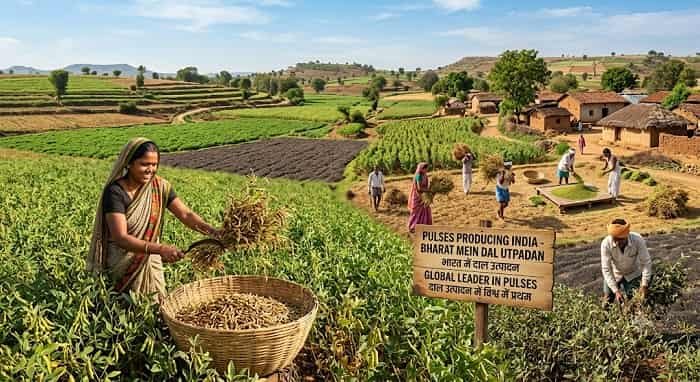
Oilseeds are the quiet golden engine of India’s food economy. Before mustard oil reaches a kitchen, before groundnut becomes cooking oil or snack, before soybean enters poultry feed, edible oil factories, and processed food chains, it begins with farmers sowing tiny seeds across dry fields, black soil belts, canal-irrigated plains, and semi-arid regions. These crops may look small, but they decide a big part of India’s edible oil security.
For 2026, India’s oilseed sector remains highly important because the country still depends heavily on edible oil imports. According to the Third Advance Estimates for 2025–26, India’s total oilseeds production is estimated at 43.059 million tonnes. The same estimate places groundnut at 13.074 million tonnes, soybean at 12.596 million tonnes, and rapeseed & mustard at 13.768 million tonnes.
For state ranking, the latest complete official state-wise table available in Agricultural Statistics at a Glance 2024–25 places Rajasthan, Madhya Pradesh, Maharashtra, Gujarat, and Uttar Pradesh as the five largest oilseed producing states.
1. Rajasthan
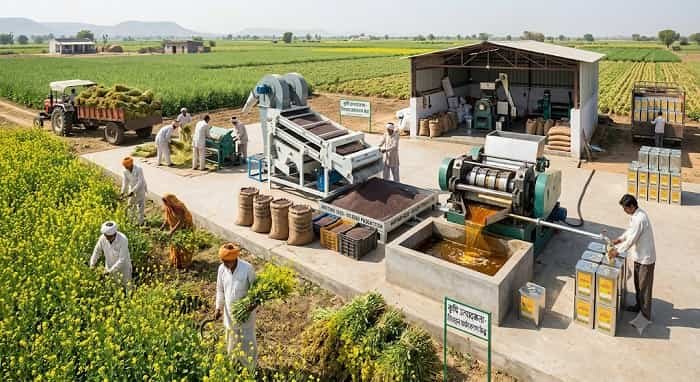
Rajasthan is the largest oilseed producing state in India. In the latest official state-wise data, Rajasthan produced around 9.20 million tonnes of oilseeds, accounting for 21.41% of India’s total oilseed production. Its oilseed area stood at about 6.08 million hectares, making it the strongest oilseed state by both scale and production share.
The main reason behind Rajasthan’s leadership is its powerful mustard belt. Rapeseed and mustard suit the state’s dry and semi-arid climate, especially where winter conditions support rabi cultivation. Districts in eastern and northern Rajasthan have long been associated with mustard farming, while groundnut and sesame also add to the state’s oilseed basket.
Rajasthan’s farmers have turned oilseeds into a major commercial crop because mustard gives good market demand and fits well into the rabi season. The state also benefits from large land availability, mandi networks, oil mills, and strong demand from edible oil processors. In 2026, Rajasthan remains India’s oilseed capital because it combines acreage, tradition, and market strength.
2. Madhya Pradesh
Madhya Pradesh ranks second among India’s largest oilseed producing states. The state produced around 8.25 million tonnes of oilseeds in 2024–25, with a national share of 19.19%. Its oilseed area was about 7.75 million hectares, the highest among the top states, though its yield was lower than Rajasthan and Gujarat.
Madhya Pradesh is best known as India’s soybean heartland. The black cotton soil of Malwa and adjoining regions supports large-scale soybean cultivation during the kharif season. Soybean has become a major cash crop for farmers in districts such as Indore, Ujjain, Dewas, Sehore, Ratlam, Dhar, Mandsaur, and nearby areas.
The state’s oilseed importance is not limited to soybean alone. Mustard, groundnut, sesame and other minor oilseeds also contribute in different regions. But soybean remains the main reason Madhya Pradesh stays so high in the national ranking.
Madhya Pradesh has a strong oilseed processing ecosystem, especially soybean crushing units and oilmeal supply chains. Its central location also helps movement of oilseeds to different parts of India. If productivity improves further, Madhya Pradesh can challenge Rajasthan more closely in coming years.
3. Maharashtra
Maharashtra stands third in India’s oilseed production map. The state produced around 7.79 million tonnes of oilseeds and contributed 18.13% to India’s total production in the latest official state-wise table. Its oilseed area was about 5.45 million hectares.
Maharashtra’s strength comes mainly from soybean, especially in Vidarbha and Marathwada. The crop is widely grown in districts such as Amravati, Akola, Washim, Yavatmal, Latur, Hingoli, Nanded and nearby areas. Soybean fits well into the state’s rainfed kharif farming pattern, though production can change sharply depending on monsoon quality.
The state also grows groundnut, sesame, sunflower and other oilseeds in smaller pockets. Its large farming base and established agro-processing network help Maharashtra remain one of India’s most important oilseed states.
One special point about Maharashtra is its link with both agriculture and industry. Oilseed production supports local traders, crushers, feed makers, edible oil units and transport businesses. In years of good rainfall, Maharashtra’s oilseed output can rise strongly, as seen in its high 2024–25 production figure.
4. Gujarat
Gujarat ranks fourth among the largest oilseed producing states in India. The state produced around 7.67 million tonnes of oilseeds, with a national share of 17.84%. Its yield was very strong at 2,293 kg per hectare, much higher than many other major states.
Gujarat’s oilseed identity is strongly linked with groundnut. Saurashtra and Kutch are famous for groundnut cultivation, and the crop has shaped the state’s edible oil economy for decades. Mustard, castor, sesame and other oilseeds also play an important role in the state’s wider oilseed basket.
The biggest advantage of Gujarat is productivity and market efficiency. The state has better irrigation in many areas, strong farmer entrepreneurship, good roads, port access, oil mills, and a long trading history. Groundnut from Gujarat is used not only for oil extraction but also for food processing and export-quality kernels.
Gujarat’s position in the top five is very strong because it produces a large volume from a smaller area compared with Madhya Pradesh and Rajasthan. This shows the state’s better yield performance and strong crop management.
5. Uttar Pradesh
Uttar Pradesh completes the list of the top five largest oilseed producing states in India. The state produced around 3.09 million tonnes of oilseeds in 2024–25 and contributed 7.18% to the national total. Its oilseed area was around 2.58 million hectares.
Uttar Pradesh’s oilseed production is mainly linked with mustard, rapeseed, groundnut, sesame and linseed in different regions. The state has a large agricultural base and a huge domestic edible oil market, which keeps oilseed cultivation relevant for farmers.
Western Uttar Pradesh, Bundelkhand and parts of eastern Uttar Pradesh contribute to the oilseed economy in different ways. Mustard performs well in the rabi season, while sesame and groundnut are grown in suitable dryland pockets. Because Uttar Pradesh has a very large population, local edible oil demand is also naturally high.
Compared with Rajasthan, Madhya Pradesh, Maharashtra and Gujarat, Uttar Pradesh’s production share is smaller. Still, its large farming area, rising demand and crop diversification potential keep it firmly in the top five.
Final Words
The top five largest oilseed producing states in India in 2026 are Rajasthan, Madhya Pradesh, Maharashtra, Gujarat and Uttar Pradesh. Rajasthan leads through mustard, Madhya Pradesh and Maharashtra dominate through soybean, Gujarat remains powerful in groundnut and high productivity, while Uttar Pradesh adds a large northern oilseed base. Together, these five states produce nearly 84% of India’s oilseeds, making them the backbone of the country’s edible oil security.