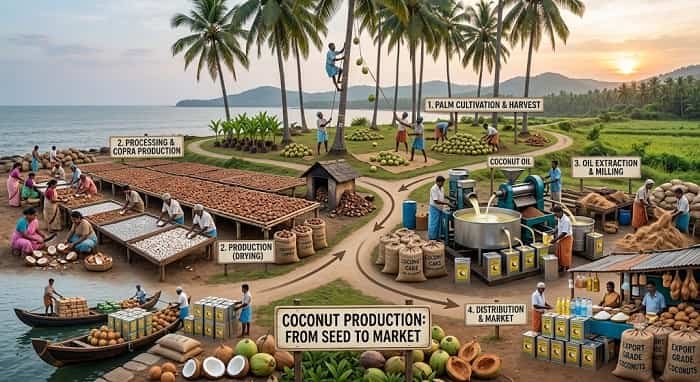
Coconut is one of India’s most useful plantation crops. It gives tender coconut water, copra, coconut oil, coir fibre, shell products, sweets, chutneys, cosmetics, soaps and many value-added foods. In coastal and southern India, the coconut tree is not just a farm crop; it is part of daily cooking, temple rituals, rural income and village life.
India is one of the world’s leading coconut producers, and most of the country’s coconut economy is concentrated in the southern states. Coconut farming depends on warm climate, good rainfall or irrigation, sandy-loam soil, proper spacing, pest control and regular market access. For this 2026 list, the ranking is based on the latest available production pattern, state-level horticulture updates, major coconut belts and the overall strength of each state in cultivation, processing and market movement.
Now let’s check out the top 5 highest coconut producing states in India in 2026.
1. Karnataka
The state has a huge coconut belt spread across both inland and coastal regions. Tumakuru, Hassan, Mandya, Chamarajanagar, Mysuru, Dakshina Kannada, Udupi, Chikkamagaluru and parts of Shivamogga are important coconut-growing areas. Tumakuru is especially known as one of the strongest coconut districts in the state.
Karnataka’s strength is that coconut is grown not only in coastal farms but also in dry and semi-irrigated inland belts. Many farmers depend on coconut for tender nuts, copra, oil extraction and local trading. The crop is also mixed with arecanut, banana, pepper and other crops in several regions.
The state is also trying to strengthen coconut marketing. In 2026, Karnataka approved a wholesale tender coconut market at Santhemarahalli in Chamarajanagar district to help farmers from Chamarajanagar and Mysuru get better auction-based prices. The report mentioned coconut cultivation over more than 13,000 hectares in Chamarajanagar and over 12,000 hectares in Mysuru.
Karnataka deserves the first position because it has a large coconut area, strong farmer base, tender coconut markets, copra movement and both coastal and inland production belts.
2. Tamil Nadu
The state has one of the most productive coconut farming systems in India. Coconut is grown widely in Coimbatore, Tiruppur, Thanjavur, Dindigul, Erode, Salem, Tirunelveli, Kanyakumari, Theni and Pollachi region. Pollachi is especially famous for coconut, tender coconut, copra and coconut-based trade.
Tamil Nadu’s advantage is productivity and commercial farming. Many farmers use irrigation, improved varieties, intercropping and organised market channels. Coconut from Tamil Nadu is used for tender coconut, coconut oil, copra, desiccated coconut, sweets, food processing and household consumption.
The state also has a strong value-added coconut economy. In 2026, coconut farmers in Tamil Nadu appealed for easier norms for neera production, saying that neera could improve farmer income and create more value from coconut palms.
Tamil Nadu deserves second position because it combines high productivity, strong coconut belts, value-added products and active farmer demand for better processing opportunities.
3. Kerala
Coconut is almost part of Kerala’s identity. The state’s name itself is often linked with the idea of “land of coconuts,” and coconut is used in daily cooking, oil, sweets, religious rituals, coir products and traditional medicine. Almost every part of Kerala has some connection with coconut.
Major coconut-growing districts include Kozhikode, Malappuram, Kannur, Kasaragod, Thrissur, Ernakulam, Alappuzha, Kollam, Thiruvananthapuram, Kottayam and Palakkad. Coastal Kerala and homestead gardens are especially important because coconut trees are grown around houses, fields, canals and backwater regions.
Kerala has the largest cultural connection with coconut in India. The Coconut Development Board is also headquartered in Kochi, which gives the state a special place in the national coconut sector. The board works for the development of coconut production, productivity and product diversification in India.
Kerala deserves third position because coconut is deeply linked with its food, economy, coir industry, small farmers and rural households. However, the state also faces problems like ageing palms, diseases and lower productivity in some belts.
4. Andhra Pradesh
The state has important coconut-growing regions along the coastal belt. East Godavari, West Godavari, Konaseema, Krishna, Kakinada, Srikakulam, Vizianagaram and Visakhapatnam are major coconut-linked districts. The Godavari delta and Konaseema region are especially famous for coconut gardens.
Andhra Pradesh has a strong horticulture base, and the state government has placed horticulture at the centre of its growth plan. In the 2026–27 budget, the state allocated ₹1,223.86 crore for horticulture and allied departments, while also highlighting Andhra Pradesh’s strong position in crops such as oil palm, papaya, cocoa, tomato and coconut.
The state’s coconut farmers also face serious pest challenges. In the Uddanam region of Srikakulam district, rugose spiralling whitefly infestation affected coconut plantations and reduced yields sharply in many farms. The region has over 60,000 acres of coconut cultivation and supports more than 1.5 lakh farmers, labourers and traders.
Andhra Pradesh deserves fourth position because of its strong coastal coconut belt, horticulture push, Konaseema identity and large farmer dependence on coconut-based income.
5. West Bengal
The state is not as dominant as Karnataka, Tamil Nadu, Kerala or Andhra Pradesh, but it has an important coconut-growing belt in eastern India. Coconut is grown mainly in coastal and humid districts such as South 24 Parganas, North 24 Parganas, Purba Medinipur, Paschim Medinipur, Howrah, Hooghly and parts of Nadia.
West Bengal’s climate supports coconut in many lowland and coastal regions. The crop is used for tender coconut, household cooking, sweets, religious offerings and local trade. Coconut demand is high in Bengal because it is widely used in puja, traditional sweets, chutneys and festive food.
The state’s coconut economy is smaller in scale, but its role is important because eastern India has fewer large coconut-producing states compared with the south. West Bengal helps meet regional demand and supports small farmers in coastal belts.
West Bengal deserves fifth position because it has suitable coastal-humid conditions, strong local demand and an established coconut-growing base in eastern India.
Final Words
The top five coconut producing states in India in 2026 are Karnataka, Tamil Nadu, Kerala, Andhra Pradesh and West Bengal. These states keep India’s coconut economy strong through tender coconut, copra, oil, coir, food processing and local trade.
Coconut farming has a bright future if farmers get better varieties, pest control, replanting support, irrigation, neera processing, coir development and stronger value-added markets.