Barley is one of India’s important rabi cereals, though it is not as widely discussed as wheat or rice. It is used for animal feed, food products, malt, beer industry, health foods and traditional preparations. For many farmers in dry and semi-dry regions, barley is useful because it can tolerate relatively tougher conditions compared with some other winter crops.
Barley farming is mainly concentrated in north-western and central India. The crop grows well in cool winter weather and does not need as much water as wheat. For this 2026 list, the ranking is based on the latest available production pattern, traditional barley belts, rabi crop strength and state-wise cultivation importance. Rajasthan remains the strongest barley state, while Uttar Pradesh, Haryana, Madhya Pradesh and Punjab form the next important group. Rajasthan is also known for cultivating wheat and barley over large areas, while north-western winter crop states remain important for cereals and rabi farming.
Now let’s check out the top 5 barley producing states in India in 2026.
1. Rajasthan
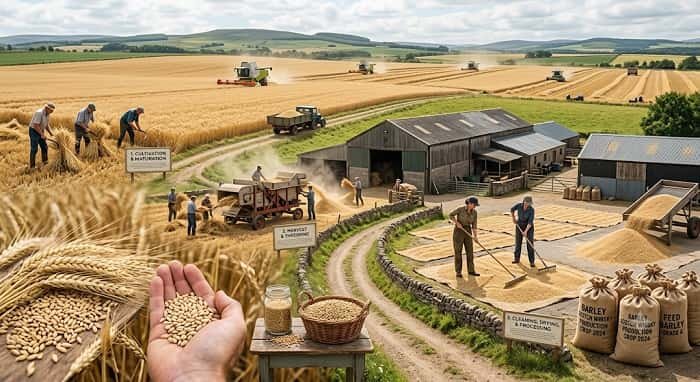
The state has the strongest barley cultivation base in the country. Barley suits Rajasthan’s dry and semi-arid conditions because it can grow with less water than many other rabi crops. This makes it useful in areas where farmers cannot always depend on high irrigation.
Major barley-producing districts include Jaipur, Alwar, Sikar, Jhunjhunu, Nagaur, Churu, Hanumangarh, Sri Ganganagar, Ajmer, Bharatpur and parts of Bikaner. The crop is grown in both irrigated and semi-irrigated belts, often along with wheat, mustard, gram and other rabi crops.
Rajasthan’s advantage is its large area and dry winter climate. In many parts of the state, barley fits naturally into the farming system because it can handle lighter soils and limited moisture better than wheat. The state also benefits from irrigation in selected regions through wells, tanks and canal systems such as the Indira Gandhi Canal.
Rajasthan deserves the first position because it has the largest traditional barley belt, strong farmer familiarity, suitable climate and a clear production lead over other states.
2. Uttar Pradesh
The state has a large rabi farming base and grows barley mainly in western and central districts. Important barley-growing regions include Agra, Mathura, Aligarh, Etah, Mainpuri, Etawah, Kanpur, Farrukhabad, Hardoi, Bareilly and parts of Bundelkhand. Western Uttar Pradesh is especially suitable because of its lighter loam soils in some belts and strong winter crop system.
Uttar Pradesh is better known for wheat, rice, sugarcane and pulses, but barley also has an important place in selected regions. The crop is grown where farmers want a hardy cereal that requires less water and can be used for feed or malt purposes.
The state’s strength is scale. Even if barley is not the main cereal, Uttar Pradesh’s huge agricultural area keeps it among India’s largest producers. Its fertile plains and rabi-season farming system make it a natural barley-growing state. Western Uttar Pradesh has lighter-textured loam and sandy soil pockets, which support crops like barley in suitable areas.
Uttar Pradesh deserves second position because of its large cultivation base, strong rabi farming network and steady barley production in western and central districts.
3. Haryana
The state has a strong rabi crop economy, supported by irrigation, mechanised farming and experienced farmers. Barley is grown mainly in southern, western and central Haryana, especially in districts such as Hisar, Bhiwani, Mahendragarh, Rewari, Sirsa, Fatehabad, Rohtak, Jhajjar and parts of Gurugram.
Haryana’s barley farming is closely linked with feed, fodder and malt demand. The state has a strong livestock economy, and barley can be useful for animal feed. It also has proximity to processing and brewing-industry demand in north India.
The state’s agriculture is highly organised. Haryana has strong irrigation coverage, and its rabi farming system is already built around wheat, mustard, gram and other winter crops. This makes barley easier to fit into suitable dry or semi-irrigated regions. Haryana’s agricultural development has been strongly supported by irrigation systems and Green Revolution-era farming infrastructure.
Haryana deserves third position because of its productive farms, market access, irrigation support and strong winter-cereal cultivation system.
4. Madhya Pradesh
Madhya Pradesh ranks fourth among India’s major barley producing states. The state has a large agricultural base and grows barley in selected rabi belts. Important regions include Morena, Bhind, Gwalior, Shivpuri, Datia, Neemuch, Mandsaur, Ratlam, Ujjain and parts of Malwa and Chambal. In these regions, barley is grown along with wheat, gram, mustard and other winter crops.
Madhya Pradesh is not as famous for barley as Rajasthan, but it remains important because of its large rabi area and dryland farming conditions. The crop can be useful in areas where farmers want a lower-water cereal option or where soil and weather conditions suit barley better than wheat.
The state’s rabi crops are sensitive to winter weather. In 2026, central and northern crop regions, including Madhya Pradesh, faced concern from hotter and drier February conditions that could affect winter crops. Such weather risks matter for barley too, because high temperature during grain filling can reduce yield.
Madhya Pradesh deserves fourth position because it has suitable rabi belts, large agricultural land and growing importance in dryland cereal production.
5. Punjab
Punjab is better known for wheat and rice, but barley is also grown in selected areas. Important barley-growing pockets are found in districts such as Bathinda, Mansa, Ferozepur, Fazilka, Muktsar, Sangrur and parts of south-western Punjab. These are areas where farmers may choose barley in specific soil and water conditions.
Punjab’s advantage is productivity. The state has highly mechanised farms, irrigation, strong mandis and experienced cereal growers. Even though barley area is smaller than wheat, the state can produce good yields where farmers grow it under proper management.
Barley also has industrial value. Demand from malt, beer and feed industries gives the crop a market beyond direct food use. Punjab’s location near Haryana, Rajasthan, Delhi-NCR and processing centres helps support this demand.
Punjab deserves fifth position because it has a strong winter-cereal system, good productivity and market access. Its total barley area is smaller than the top states, but its farming efficiency keeps it important in India’s barley map.
Final Words
The top five barley producing states in India in 2026 are Rajasthan, Uttar Pradesh, Haryana, Madhya Pradesh and Punjab. Rajasthan is the clear leader because of its large dryland barley belt.
Barley can become more valuable in India if farmers get better varieties, malt-industry support, assured markets and climate-resilient crop planning.