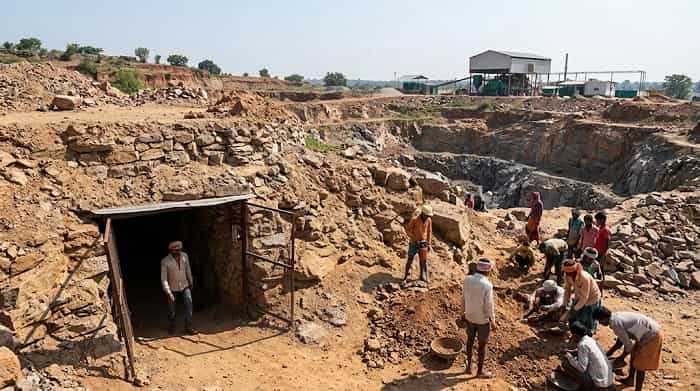
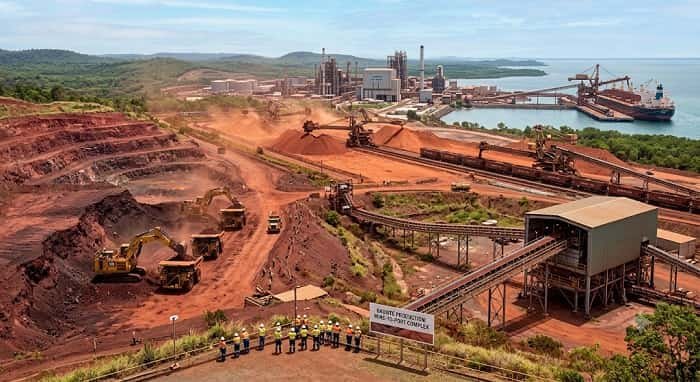
Bauxite is the red-brown rock that quietly feeds India’s aluminium dream. Before aluminium becomes aircraft parts, railway coaches, electric wires, utensils, packaging sheets, solar frames or construction material, it begins its journey from bauxite-rich plateaus and hill ranges. Trucks climb dusty mining roads, ore moves to refineries, and alumina finally turns into aluminium metal. It is one of those minerals that looks ordinary in the soil but becomes highly valuable once it enters industry.
For 2026, the latest Ministry of Mines Annual Report estimates India’s bauxite production at 25.78 million tonnes in 2025–26, showing a rise of 4.18% over the previous year. The report also says that companies such as Utkal Alumina, NALCO, Odisha Mining Corporation and Hindalco dominate bauxite mining activity in India.
1. Odisha
Odisha is the undisputed king of bauxite production in India. In the 2025–26 estimate, Odisha alone accounts for 75.13% of India’s bauxite production, far ahead of every other state.
The state’s biggest strength is its rich bauxite deposits in the Eastern Ghats, especially around Koraput, Kalahandi, Rayagada and nearby plateau regions. These areas have large lateritic bauxite deposits suitable for aluminium production. Odisha also has a strong aluminium industry ecosystem, with mines, refineries, smelters, transport networks and large companies working together.
The famous Panchpatmali bauxite mines in Damanjodi, Koraput, are among India’s most important bauxite mining locations. NALCO’s alumina refinery is also located at Damanjodi, close to the bauxite mines, which makes the mining-to-refining chain stronger.
Odisha’s dominance is so large that India’s bauxite map almost begins with Odisha. The state does not just produce bauxite; it supports India’s aluminium industry from the ground level.
2. Gujarat
Gujarat ranks second among India’s major bauxite producing states in 2026. The Ministry of Mines mentions Gujarat as one of the major bauxite producers, with an estimated 8.35% share in 2025–26.
Gujarat’s bauxite deposits are mainly found in western coastal and semi-arid regions. Important bauxite-bearing areas include parts of Jamnagar, Kutch, Devbhumi Dwarka, Porbandar and Junagadh. The state’s advantage is its strong industrial base and excellent port connectivity.
Unlike Odisha, Gujarat may not have the same massive share, but it has a practical location advantage. Bauxite from Gujarat can serve refractory, cement, abrasive, chemical and aluminium-related industries. Its ports also help in mineral movement and trade.
Gujarat’s mining sector is well connected with manufacturing. This makes the state important not only as a producer but also as a supplier to different industrial users. In 2026, Gujarat remains India’s second-largest bauxite-producing state because of its steady output and strong mineral economy.
3. Jharkhand
Jharkhand stands third in India’s bauxite production list. The Ministry of Mines places Jharkhand among the major bauxite producing states, with about 7.94% share in the 2025–26 estimate.
Jharkhand is already one of India’s richest mineral states, known for coal, iron ore, copper, uranium and other minerals. Bauxite adds another important layer to its mining profile. The main bauxite-producing belt lies in areas such as Lohardaga, Gumla and Latehar.
Lohardaga is especially famous for bauxite mining. The ore from this region has supported alumina and aluminium industries for many years. Jharkhand’s hilly terrain and lateritic plateaus provide suitable geological conditions for bauxite deposits.
The state’s challenge is balancing mining with forest protection, tribal livelihoods and local development. But from a production point of view, Jharkhand remains a key bauxite state. Its position after Odisha and Gujarat shows that eastern India continues to dominate the bauxite sector.
4. Maharashtra
Maharashtra comes fourth in the top bauxite producing states of India. In the latest complete state-wise mineral scenario for 2024–25, Maharashtra accounted for 4.62% of India’s bauxite production, placing it slightly ahead of Chhattisgarh.
The state’s bauxite deposits are mainly found in the Konkan region and parts of western Maharashtra, including areas connected with Kolhapur, Ratnagiri, Sindhudurg and Raigad. These deposits are often linked with lateritic plateaus formed under heavy rainfall and tropical weathering.
Maharashtra’s strength is its industrial demand. The state has a large manufacturing base, ports, transport networks and nearby markets. Even if its production share is much smaller than Odisha, it plays a useful role in regional supply.
Maharashtra is also important because bauxite is not used only for aluminium. Certain grades are used in cement, refractories, abrasives and chemical industries. This gives the state’s bauxite mining a broader industrial connection.
5. Chhattisgarh
Chhattisgarh completes the list of India’s top five bauxite producing states. The latest complete state-wise mineral scenario gives Chhattisgarh a 4.30% share in India’s bauxite production for 2024–25.
Chhattisgarh’s bauxite deposits are found in areas such as Surguja, Kanker, Korba and Bastar region. The state is already known for coal, iron ore, limestone and other minerals, but bauxite has also become an important part of its mineral economy.
One reason Chhattisgarh is important is its large resource potential. The state has several plateau and hill areas where bauxite occurs in lateritic formations. In recent years, new bauxite blocks in Chhattisgarh have also appeared in mineral exploration and auction-related activity, showing that the state may become more important in future.
Chhattisgarh’s future in bauxite will depend on responsible mining, local community protection, forest clearances and stronger industrial linkage. If handled carefully, the state can improve its position in India’s bauxite production map.
Why Bauxite Is Important for India
Bauxite is the main ore of aluminium. Aluminium is lightweight, corrosion-resistant and highly useful in transport, power, defence, packaging, renewable energy, construction and consumer goods. The Ministry of Mines notes that India is self-sufficient or near self-sufficient in bauxite, which makes it a strategically important mineral for domestic industry.
Final Words
The top five largest bauxite producing states in India in 2026 are Odisha, Gujarat, Jharkhand, Maharashtra and Chhattisgarh. Odisha is far ahead and controls nearly three-fourths of India’s bauxite production. Gujarat and Jharkhand form the next strong producing group, while Maharashtra and Chhattisgarh complete the top five with smaller but important shares. Together, these states support India’s aluminium industry and play a key role in the country’s mineral-based industrial growth.