India’s food plate changes every few hundred kilometres. In one region, lunch means dal, roti and sabzi. In another, it is rice with fish curry. Somewhere else, chicken biryani, mutton curry, egg curry, prawns, crab or dried fish become part of everyday taste. This is what makes India’s food culture so colourful — no single food habit can define the whole country.
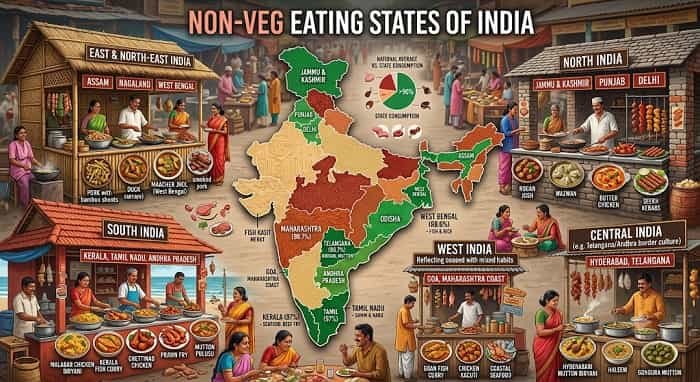
For this 2026 list, the ranking is based on the share of non-vegetarian population, meaning people who consume egg, fish, chicken or meat. The latest widely used state-wise food-habit data shows that India is not a mostly vegetarian country. NFHS-based reporting has shown that around 70% of women and 78% of men in India consume some form of non-vegetarian food, while several eastern and southern states have more than 97% non-vegetarian population.
Now let’s check out the top 5 most non-veg eating states in India in 2026.
1. Telangana
Telangana is one of the most non-veg eating states in India in 2026.
The state has one of the lowest vegetarian population shares in the country, which means non-vegetarian food is part of daily life for a very large majority of people. Data cited from the Registrar General of India shows Telangana with only around 1.3% vegetarian population, making it one of India’s strongest non-veg eating states by share.
Telangana’s food culture is deeply connected with meat-based dishes. Hyderabad is famous for biryani, haleem, kebabs, chicken dishes, mutton curries and spicy meat preparations. In rural Telangana also, non-veg food is common during festivals, family functions, weekly markets and special occasions.
Fish consumption is also important in many parts of the state. Inland fish from tanks, reservoirs and rivers is widely eaten. Chicken and mutton are especially popular in urban areas, while traditional village-style meat curries remain a strong part of local food culture.
Telangana deserves the first position because non-vegetarian food is not limited to restaurants or festivals here. It is part of regular household eating, city food culture and traditional cuisine.
2. West Bengal
West Bengal ranks second among the most non-veg eating states in India in 2026.
Bengal’s food identity is almost impossible to separate from fish. Rice and fish curry are not just meals here; they are part of emotion, memory and daily culture. The state has one of India’s lowest vegetarian population shares, with vegetarianism estimated at only around 1.4%, which places West Bengal among the highest non-vegetarian states in the country.
Fish is the heart of Bengali non-veg food. Rohu, katla, hilsa, pabda, chingri and many other varieties are used in daily cooking. Dishes like machher jhol, shorshe ilish, chingri malai curry and fish fry are famous across India.
Apart from fish, chicken and mutton are also widely eaten. Kolkata’s biryani, mutton kosha, egg rolls and chicken rolls have become iconic street and restaurant foods. Even in smaller towns and villages, fish markets are a regular part of daily life.
West Bengal deserves second position because non-veg eating is deeply rooted in both home cooking and public food culture. Fish is almost a cultural symbol of the state.
3. Andhra Pradesh
Andhra Pradesh stands third among India’s top non-veg eating states in 2026.
The state is known for bold, spicy and flavour-rich food. Andhra cuisine has a strong non-vegetarian identity, especially through chicken, mutton, prawns, fish and crab dishes. Vegetarian population in Andhra Pradesh is estimated at only around 1.75%, showing that non-vegetarian food is consumed by a huge majority of people.
Andhra Pradesh also has a strong connection with fisheries and aquaculture. The state is a major fish-producing region and has been reported to contribute a very large share to India’s fish production and seafood exports. This naturally supports fish and prawn consumption in coastal and inland areas.
Coastal Andhra is famous for fish curry, prawn curry, crab preparations and dry fish dishes. Rayalaseema is known for spicy chicken and mutton dishes. In cities like Vijayawada, Visakhapatnam, Guntur, Kurnool and Rajahmundry, non-veg meals are extremely common.
Andhra Pradesh deserves third position because its food culture, fish economy, spice tradition and everyday eating habits strongly support non-vegetarian consumption.
4. Tamil Nadu
Tamil Nadu ranks fourth among the most non-veg eating states in India in 2026.
The state has a very rich food culture where both vegetarian and non-vegetarian dishes are important. But in terms of population share, non-vegetarian food is extremely common. Vegetarian population in Tamil Nadu is estimated at only around 2.35%, which means most people consume egg, fish, chicken or meat.
Tamil Nadu’s non-veg food is highly diverse. Coastal districts are known for fish, prawns and crab. The Chettinad region is famous for spicy chicken and mutton dishes. Madurai, Dindigul, Salem, Tirunelveli, Chennai and Coimbatore all have their own strong non-veg food identities.
Dishes like Chettinad chicken, mutton chukka, fish curry, nethili fry, chicken salna, egg curry and biryani are very popular. Tamil Nadu also has a strong culture of small non-veg hotels where chicken, mutton and fish meals are served with rice, rasam and gravies.
Tamil Nadu deserves fourth position because non-veg food is widely accepted across rural, urban, coastal and inland regions of the state.
5. Odisha
Odisha completes the list of the top five most non-veg eating states in India in 2026.
Odisha is often known for temple food, pakhala, dalma and sweets, but the state also has a very strong non-vegetarian food culture. Vegetarian population in Odisha is estimated at only around 2.65%, placing it among India’s leading non-veg eating states.
Fish is extremely popular in Odisha. The state has a long coastline, many rivers, reservoirs and wetlands, which support both marine and freshwater fish consumption. Rohu, catla, prawns, crabs and small fish are commonly used in Odia kitchens.
Chicken and mutton are also widely eaten, especially during festivals, family functions, Sunday meals and local feasts. Many Odia households enjoy fish curry with rice, while coastal areas have a stronger seafood culture. Odisha’s cuisine uses mustard paste, garlic, onion, green chilli and traditional spices to create simple but flavourful fish and meat dishes.
Odisha deserves fifth position because non-veg food is deeply present in everyday meals, coastal food habits and rural-urban household cooking.
Final Words
The most non-veg eating states in India are mainly found in eastern and southern India. Telangana, West Bengal, Andhra Pradesh, Tamil Nadu and Odisha stand out because vegetarian population is very low and fish, chicken, meat or eggs are widely consumed. Jharkhand also comes very close to this group, but these five states remain among the strongest non-veg food regions in India.
Food habits are personal and cultural, so this ranking should not be seen as better or worse. It simply shows how diverse India’s eating pattern is — from fish-loving Bengal and Odisha to spicy meat-rich Telangana, Andhra Pradesh and Tamil Nadu.